

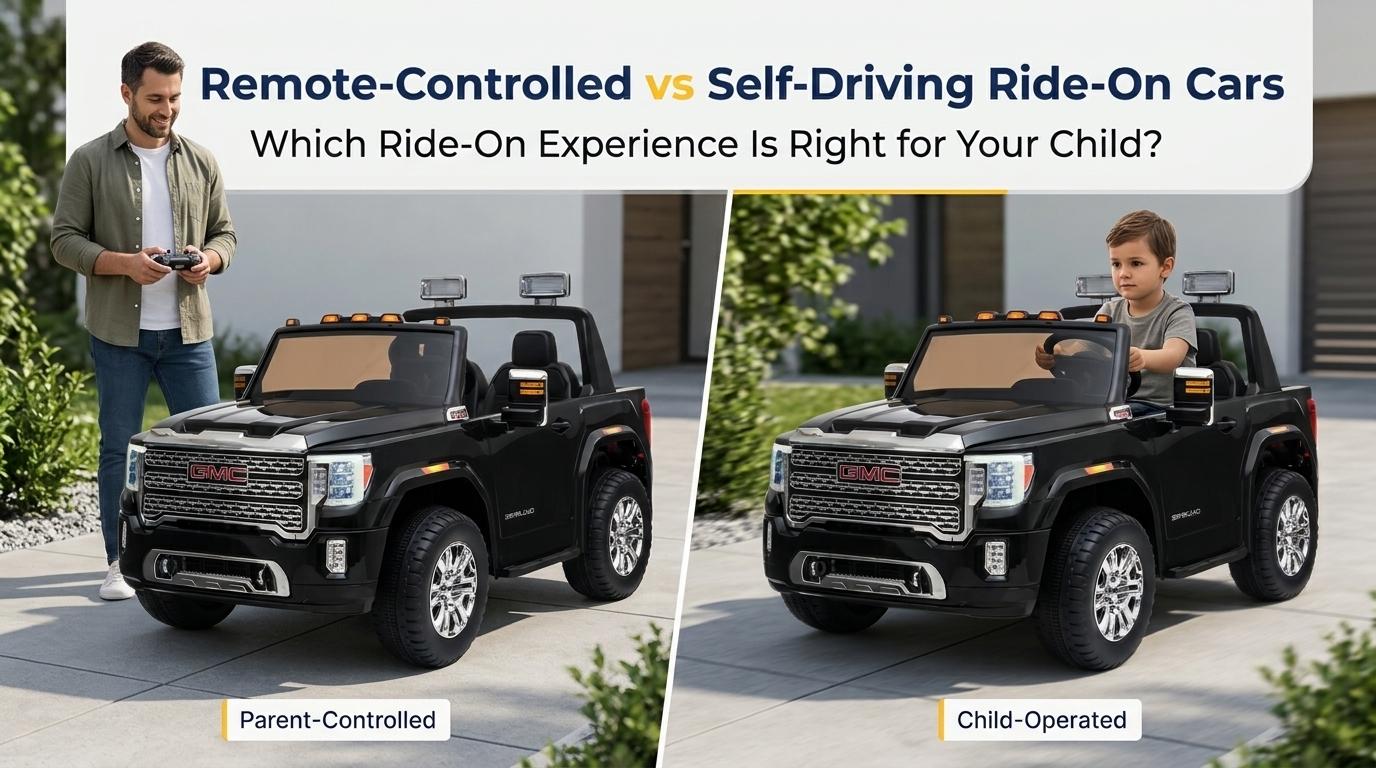
Kids car designs offer different driving experiences depending on how the vehicle is operated. Some models allow parents to control movement using a remote, while others let children manage steering, acceleration, and movement independently. Both options have their own advantages, and the right choice depends on the child's age, coordination, and experience. Understanding how these two operating systems work can help parents select a suitable vehicle that provides an enjoyable experience while maintaining appropriate adult supervision.
What Are Remote-Controlled Ride-On Vehicles?
Remote-controlled models allow parents or guardians to operate the vehicle using a wireless controller. Instead of relying entirely on the child to manage movement, an adult can control important functions from a distance.
These models are particularly useful for younger children who are still learning how to steer and understand basic driving controls.
How Does the Remote Control Work?
A wireless remote communicates with the vehicle's electronic control system. Depending on the model, parents may be able to:
- Move the vehicle forward and backward.
- Turn left or right.
- Control movement at different speeds.
- Stop the vehicle when necessary.
Some models also allow children to operate the steering wheel and accelerator themselves while parents retain remote control.
This combination provides flexibility because adults can assist when needed without taking away every opportunity for independent play.
What Are Self-Driving Ride-On Vehicles?
Self-driving, in this context, refers to vehicles that children operate themselves rather than models controlled by an adult using a remote.
These vehicles usually include a steering wheel, accelerator pedal, and sometimes a brake pedal or forward and reverse controls.
Children use these features to manage their movement and direction.
How Do Child-Operated Controls Work?
The operating process is generally straightforward:
- The child sits in the driving seat.
- They use the steering wheel to select a direction.
- Pressing the accelerator activates the motor.
- Releasing the accelerator reduces or stops powered movement, depending on the model.
- Additional controls may allow forward or reverse operation.
These features help children become familiar with basic steering and movement while enjoying independent play.
It is worth noting that these vehicles are not autonomous cars. They do not independently navigate roads or make driving decisions.
Key Differences Between Both Designs
Although both types offer similar recreational experiences, their operating systems provide different levels of parental involvement.
1. Driving Control
Remote-controlled models give parents greater control over movement. This can be helpful when children are too young or inexperienced to operate the vehicle confidently.
Child-operated models provide more independence because the child manages steering and acceleration.
2. Parental Supervision
Remote control offers an additional way for adults to intervene when necessary.
For example, if a child approaches an unsuitable area, a parent can use the controller to stop or redirect a compatible model.
However, remote control does not replace direct supervision.
3. Learning Experience
Child-operated models allow children to practise basic coordination and understand how steering and acceleration work together.
Remote-controlled versions can also support learning, particularly when parents gradually introduce independent operation.
4. Operating Convenience
Remote-controlled models can be convenient when younger children need assistance.
Child-operated designs may be more suitable when children already understand the basic controls and can manage movement within the manufacturer's recommended conditions.
Which Option Is More Suitable for Different Ages?
Age and individual development are important when selecting between these operating systems.
Toddlers and Younger Children
Younger children may benefit from remote-controlled models because they are still developing coordination and understanding of movement.
Parents can manage the vehicle while introducing children to steering and basic controls.
Preschool Children
Children who are becoming more confident may enjoy models that combine parental remote control with independent operation.
This arrangement allows parents to provide assistance while children gradually become familiar with the controls.
Older Children
Older children with suitable coordination and experience may prefer independently operated models.
They can manage steering, acceleration, and direction themselves, provided the vehicle matches their age, height, weight, and abilities.
What Features Should Parents Compare?
When comparing a toy car, parents should look beyond its operating system and examine other important specifications.
Remote-control range: Check how far the controller can communicate with the vehicle under normal conditions.
Speed settings: Different speed options can help parents select an appropriate operating level.
Braking system: Understand how the vehicle stops and whether the remote provides an emergency stop function.
Battery performance: Compare battery capacity, charging requirements, and estimated running time.
Seating and comfort: Check seat dimensions, back support, and safety belts where provided.
Construction quality: Examine the wheels, steering components, body structure, and overall build.
Weight capacity: Make sure the vehicle supports the child's weight according to the manufacturer's specifications.
These details help parents compare models based on practical requirements rather than appearance alone.
Can Both Operating Systems Be Combined?
Yes. Some modern models offer both remote-controlled and independent driving modes.
This combination gives parents the ability to control movement when necessary while allowing children to operate the vehicle themselves.
For example, a parent may initially use the remote controller to manage movement. As the child becomes more familiar with the steering wheel and accelerator, they can gradually take greater control.
However, available functions differ between models. Parents should check the product specifications to confirm whether both operating modes are supported.
Frequently Asked Questions (FAQs)
1. Are remote-controlled models better for younger children?
They can be a useful option because parents can manage movement while younger children become familiar with the vehicle. The manufacturer's age recommendations should always be followed.
2. Can children operate remote-controlled models themselves?
Some models support both remote operation and independent driving. However, not every remote-controlled model includes this option.
3. Do child-operated models require more coordination?
Yes. Children need to understand how to use the steering wheel, accelerator, and other available controls. Their individual development and experience should be considered.
4. Can parents stop a vehicle using its remote?
Many models include remote stopping functions, but available controls vary. Check the manufacturer's instructions before relying on this feature.
5. Which operating system offers more independence?
Child-operated models generally provide more independence because children manage their own steering and movement.
6. What should parents choose for a beginner?
A model with parental remote control can be helpful for beginners. A combination of remote and independent operation may also provide flexibility as the child becomes more confident.
Final Thoughts
Remote-controlled and child-operated vehicles offer different advantages. Remote operation gives parents additional control, while independent driving allows children to manage steering and movement themselves.
The best option depends on the child's age, coordination, experience, and the vehicle's specifications. Parents should compare operating modes alongside safety features, speed settings, battery performance, and weight capacity before making a decision. Online collections at ToysUAE provide an opportunity to explore different models and compare their available features.