Russian
 English
 Romaian
 Portuguese (Brazil)
 Greek
Greek

Coagulation Market 2030: Increasing Demand for Reagents and Consumables
Other |
2026-10-07 10:09:17
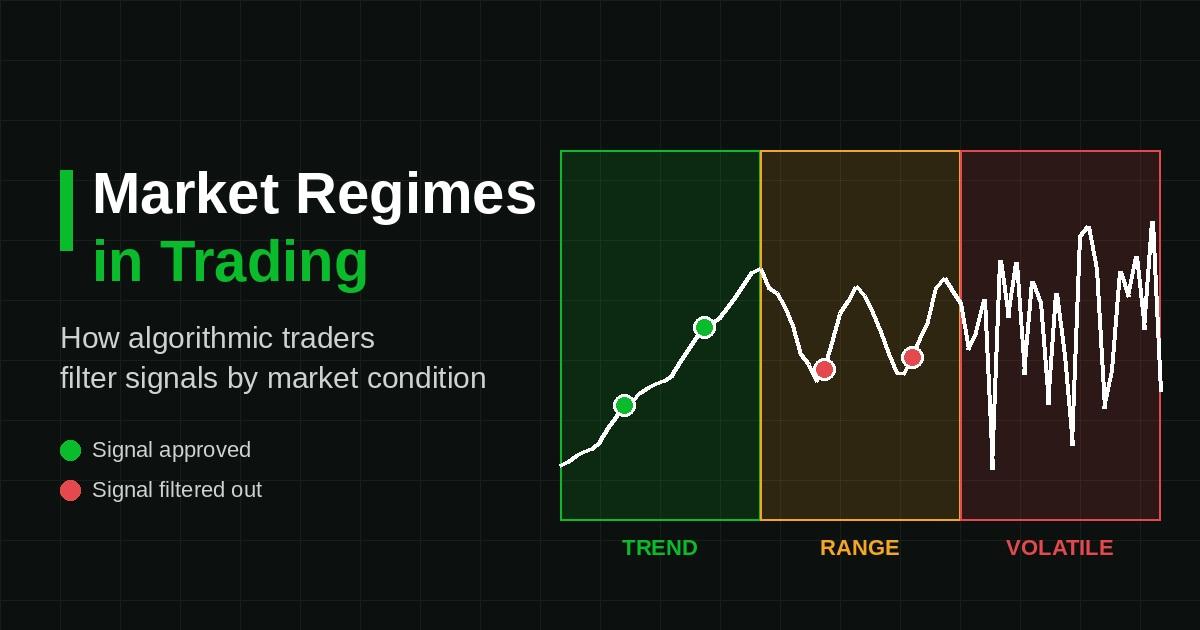
Every trading signal is born into a market that has a mood. A breakout buy signal can work beautifully in a strong trend. Yet the exact same signal can fail again and again in a sideways market. The signal did not change. The environment did.
This is why experienced algorithmic traders rarely trust a signal on its own. Instead, they first ask a simpler question: what kind of market are we in right now? The answer comes from studying market regimes in trading. Once the regime is known, signals can be accepted, reduced, or ignored.
In this guide, we explain how regime filters work, how traders detect regimes, and how they adapt their rules to each one. The goal is practical. By the end, you should understand how a regime layer can turn a noisy system into a more selective one.
Market regimes in trading are persistent states of price behavior. Each state has its own pattern of direction, volatility, and momentum. In simple terms, a regime describes how the market is behaving, not where it is going next.
Most traders work with four broad regimes:
Some desks split these further. For example, a trend can be quiet or volatile, and a range can be tight or wide. However, the core idea stays the same. Each regime rewards a different style of trading.
Importantly, regimes tend to persist. A trending market often keeps trending for weeks. Likewise, a quiet range can last far longer than most traders expect. This persistence is exactly what makes regime filtering useful.
Most trading strategies are built for one kind of market. A moving average crossover, for instance, thrives in trends. In a choppy range, however, it buys near the top and sells near the bottom. The result is a long series of small losses, often called whipsaws.
Over many years of testing systems, one pattern shows up repeatedly. Strategies rarely fail because their logic is wrong. Instead, they fail because they are applied in the wrong regime. A regime filter addresses this problem directly.
Here is what a well-built filter can do:
Note that a filter does not create an edge on its own. Rather, it protects an existing edge by deciding when that edge is likely to be present. As a result, a filtered system often trades less, yet each trade carries better odds.
There is no single perfect regime detector. Therefore, most professionals combine two or three simple measures. Each one looks at a different side of price behavior.
The Average Directional Index (ADX) measures trend strength, not direction. Readings above 25 usually point to a trending market. Readings below 20, on the other hand, suggest a weak trend or a range. Many traders pair ADX with the +DI and -DI lines to confirm direction.
A long moving average, such as the 200-period, offers a clean directional bias. When price holds above a rising average, the regime leans bullish. Conversely, price below a falling average leans bearish. When the average turns flat and price keeps crossing it, a range is likely.
Volatility tells traders how much risk the market is carrying. Common tools include Average True Range (ATR), Bollinger Band width, and historical volatility. For example, a sharp rise in ATR compared with its own average often signals a shift into a high-volatility regime. In contrast, narrow bands often mark a quiet range that may soon break.
More advanced desks use statistical models. Hidden Markov Models, for instance, estimate the probability of being in each regime. Clustering methods group past market days by similar features. These tools can be powerful. However, they are also easy to overfit, so they must be tested carefully on out-of-sample data.
In practice, simple rules often hold up better than complex ones. A clear, explainable detector is also easier to trust when markets become stressful.
A regime filter sits between the signal and the order. First, the signal engine produces a buy or sell idea. Next, the filter checks the current regime. Finally, the trade is either approved, resized, or rejected.
The workflow usually follows these steps:
Consider a simple example. Suppose a system generates a long breakout signal on a stock index. If ADX is above 25 and price sits above a rising 200-period average, the filter approves the trade. If ADX is below 20, however, the same breakout is treated as suspect. In that case, the signal is skipped because breakouts inside ranges often fail.
Meanwhile, direction matters too. A short signal during a strong uptrend fights the dominant flow. Many filters therefore block counter-trend trades unless a separate reversal model confirms them. Through this approach, market regimes in trading act as a quality gate rather than a prediction tool.
Sideways markets frustrate trend followers. Yet they also create clear opportunities for those using the right tools. Range-bound market strategies focus on buying weakness near support and selling strength near resistance.
Common approaches include:
However, range trading carries one major risk: the breakout. Ranges do not last forever. When volatility expands and ADX starts rising, the regime may be shifting. At that point, range-bound market strategies should be paused or switched off. Otherwise, a single breakout can erase many small wins.
For this reason, experienced traders always use hard stops outside the range. They also reduce size when bands begin widening after a long squeeze.
Filtering signals is only the first step. Skilled traders also adapt trading strategy to market conditions across the whole trade, from entry to exit. In other words, the regime shapes how much to risk, where to place stops, and when to take profit.
Position sizing. Size is usually set as a fixed share of capital divided by volatility. When ATR doubles, position size is often cut in half. This keeps the money at risk roughly constant across regimes.
Stop placement. In trends, wider ATR-based stops give trades room to breathe. In ranges, by contrast, tighter stops just outside support or resistance make more sense.
Profit targets. Trend regimes favor trailing stops, since big moves can run further than expected. Range regimes, on the other hand, favor fixed targets near the opposite boundary.
Strategy rotation. Some portfolios hold several strategies at once. The regime model then shifts capital toward the style that fits current conditions. For instance, more weight goes to trend models during strong trends and to mean reversion during quiet ranges.
Crisis mode. During extreme volatility, many traders simply step aside or trade very small. Preserving capital in these periods is often worth more than any single opportunity.
Ultimately, the aim is to adapt trading strategy to market conditions in a rules-based way. Decisions are written down in advance, so emotions play a smaller role when markets move quickly.
Even a sound idea can be misused. Over the years, a few errors appear again and again among traders who are new to market regimes in trading.
Above all, remember that regimes are probabilities, not certainties. A good filter improves the odds. It does not remove risk, so sound money management is still required.
To sum up, market regimes in trading give context to every signal. When traders identify the regime first, filter signals second, and adapt risk third, their systems tend to become calmer and more consistent.
Regime awareness is one of the most practical upgrades any trader can make. It does not require complex math, yet it changes how every signal is judged. Traders exploring tools in this space often ask whether platforms like GainzAlgo apply similar regime logic, and searches such as "is gainzalgo legit" are common. The best answer is always the same: review how any tool classifies conditions, test it on your own markets, and keep risk rules firmly in your hands.