Growing Pharmaceutical Packaging Requirements Boost Transparent Barrier Films Adoption
Other |
2026-07-30 06:52:24
 Russian
 English
 Romaian
 Portuguese (Brazil)
 Greek
A nonprofit's mission may be powerful, but people need to understand why it matters before they decide to support it. Donors, volunteers, community members, and potential partners want to know what your organization does, whom it helps, and how their involvement can make a difference.
This is where nonprofit storytelling becomes an essential part of your marketing strategy.
Instead of simply listing programs, statistics, or fundraising goals, effective storytelling connects your mission with real experiences, meaningful outcomes, and clear opportunities to get involved. It helps people understand the human impact behind your work while giving them a reason to care about what happens next.
However, nonprofit storytelling requires more than sharing emotional photographs or publishing inspirational quotes. The strongest stories are accurate, respectful, relevant to your audience, and connected to a clear purpose.
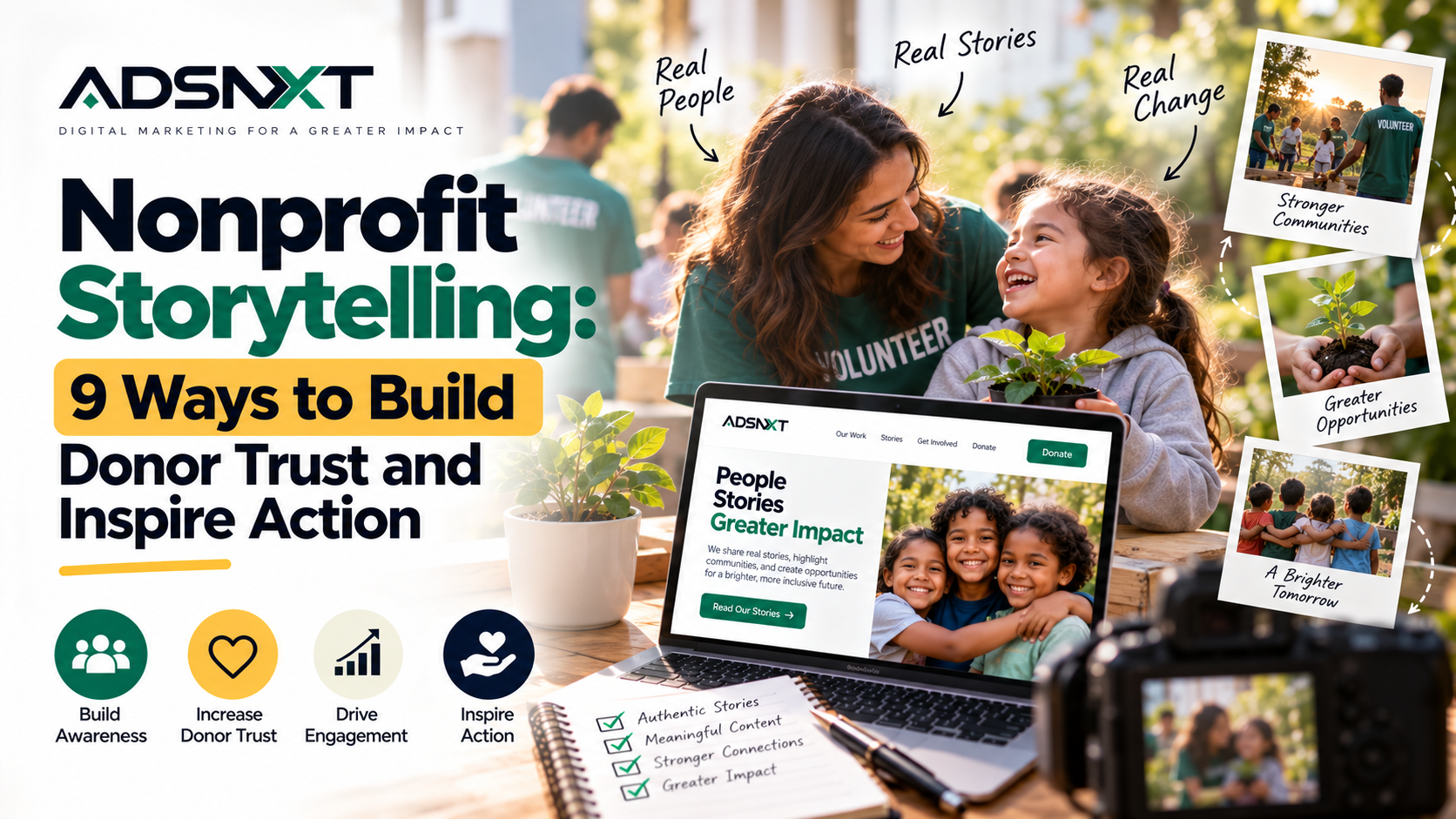
In this guide, we explore nine practical nonprofit storytelling strategies to strengthen donor trust, improve digital engagement, create more useful content, and encourage meaningful action.
Nonprofit storytelling is the practice of communicating an organization's mission, work, and impact through meaningful narratives. These stories can feature the people a nonprofit serves, volunteers, staff members, community partners, or the broader challenges the organization is working to address.
A story can explain how a community program responds to a local need, how volunteers contribute to a project, or how donor support helps sustain an important service.
Unlike a simple organizational announcement, a well-developed story gives audiences context. It explains the situation, introduces the people involved, describes the organization's response, and shows what the experience reveals about the mission.
For example, a food assistance nonprofit could publish the number of meals distributed during the previous month. That information is useful, but a story explaining how the program works, why access to nutritious food matters, and how community support sustains the service can provide additional meaning.
The two approaches work best together: stories help people understand the human context, while credible data helps demonstrate the organization's work.
Some nonprofit missions address complex problems that cannot be explained through a short slogan. Stories provide context, helping audiences understand the challenge, the organization's role, and the outcomes it hopes to achieve.
Trust grows when organizations communicate honestly about their work, acknowledge challenges, and explain results without exaggeration. Stories supported by accurate information can make an organization's activities easier to understand.
People may connect with a cause in different ways. One person might donate, another might volunteer, and someone else might share an educational resource. Stories can help each audience understand how its participation contributes to the mission.
A single well-developed story can inform a website article, email newsletter, social media post, short video, campaign landing page, or annual report. This allows nonprofit teams to communicate consistently without creating every piece of content from scratch.
The goal is not to make every message emotional. It is to make your mission understandable, credible, and relevant to the people you want to reach.
A nonprofit story becomes easier to understand when it begins with a specific experience rather than a broad organizational statement.
Consider the difference between these two openings:
General statement: Our organization supports educational opportunities for underserved communities.
Story-driven opening: Every Saturday, local volunteers help students practice reading, explore new books, and build confidence in a welcoming community learning space.
The second example gives readers a clearer picture of the work. It introduces an activity, creates context, and helps audiences visualize the program.
When selecting a story, look for experiences that illustrate your mission in a meaningful way. These might include a volunteer describing why they contribute their time, a program coordinator explaining how a service operates, or a participant sharing an experience with informed consent.
Avoid assuming that every story must describe a dramatic personal transformation. Everyday progress, community collaboration, and behind-the-scenes work can also communicate impact.
Before publishing, verify the details and ensure that the people involved understand how their experiences will be used.
Individual experiences can attract attention, but they should support the nonprofit's mission rather than overshadow it.
A common mistake is publishing an emotional story without explaining what the organization actually does. Readers may remember the individual experience but remain unclear about the program, the challenge, or how they can help.
A useful story structure includes four elements:
The need: What challenge or opportunity does the story address?
The response: How does the nonprofit or community respond?
The evidence: What progress, activity, or learning can the organization demonstrate?
The next step: How can readers participate or learn more?
For example, a literacy nonprofit could explain a local reading challenge, introduce its volunteer-led tutoring program, share verified participation information, and invite readers to explore volunteer opportunities.
This structure connects the individual story with the organization's broader work.
It also helps different marketing channels communicate a consistent message. Your website, email campaigns, social media content, and fundraising materials can all reinforce the same mission while serving different audience needs.
Strong nonprofit storytelling combines human experiences with credible information.
A personal account can illustrate why a program matters, while supporting evidence helps explain the scale, delivery, or results of the organization's work.
Useful supporting information may include:
Number of people served during a defined period
Number of volunteers contributing to a program
Services delivered or resources distributed
Participation or completion figures
Verified progress toward a stated program objective
Lessons learned from a completed initiative
Make sure every statistic has a clear source, timeframe, and meaning.
For instance, reporting that a program distributed 1,200 meals during a particular month is more informative when readers understand which program delivered them and what the figure represents.
Avoid implying that a single donation or activity produced an outcome unless you can substantiate that connection. Social challenges are often complex, and outcomes may depend on many factors.
If your organization is still evaluating a program, communicate what you have learned so far rather than presenting early observations as proven long-term results.
Honest reporting can strengthen the credibility of your storytelling, even when the results are more modest or complicated than expected.
Nonprofits sometimes work with people experiencing poverty, illness, displacement, discrimination, or other difficult circumstances. Their stories deserve particular care.
Emotional storytelling should never come at the expense of someone's dignity, safety, privacy, or ability to make informed decisions.
Before collecting or publishing a personal story, explain where it may appear, how it will be used, and whether identifying details will be included. Obtain appropriate permission and follow your organization's safeguarding, privacy, and consent procedures.
Consider these principles:
Present people as individuals with agency, skills, and perspectives.
Avoid language that reduces someone to a problem or condition.
Do not exaggerate hardship to encourage donations.
Respect requests to remain anonymous where feasible.
Remove identifying details when disclosure could create risks.
Use photographs and quotations only with appropriate authorization.
Be transparent about what the organization can and cannot promise.
Whenever possible, invite participants to review how their experiences are represented.
Ethical storytelling is not simply a communications rule. It is part of building relationships based on respect and accountability.
Not every supporter needs the same information.
A first-time visitor may want to understand your mission. A returning donor may want to know what has happened since their last contribution. A prospective volunteer may need practical information about available roles and time commitments.
Your nonprofit storytelling strategy should reflect these differences.
| Audience | Story focus | Suggested next step |
|---|---|---|
| First-time visitors | Mission, community need, and approach | Explore programs |
| Individual donors | Verified impact and ongoing needs | Make a donation |
| Existing supporters | Progress updates and lessons learned | Stay involved |
| Prospective volunteers | Team experiences and volunteer activities | View opportunities |
| Corporate or community partners | Collaboration and program delivery | Discuss partnership |
| Advocates and educators | Issue context and educational resources | Share information |
These are starting points, not rigid categories. Audience preferences vary, and some people may belong to several groups.
The important principle is relevance. Give people the information they need to understand your work and choose an appropriate next step.
For organizations with limited resources, start by adapting a few important stories for your primary audiences rather than developing a completely separate content program for everyone.
Creating original content takes time, especially for nonprofits with small communications teams. A structured content repurposing process can help extend the value of a single story.
Start with a complete, well-reviewed story on your website. Then identify smaller elements that can be adapted for other channels.
For example, a volunteer story could become:
A website article explaining the volunteer's experience
A short email introducing the program
Three social posts highlighting different lessons
A short video featuring an approved quotation
A section in a monthly supporter update
A paragraph in a relevant fundraising campaign
A brief feature in an annual report
Each version should be adapted to its channel rather than copied everywhere without changes.
A website article can provide context and supporting details. A social post can introduce one key idea. An email can connect the story to a relevant update or invitation.
Maintain consistency in the facts, message, and permissions across all formats.
This approach helps nonprofit teams publish more consistently while protecting time for program delivery and other responsibilities.
Social media can help people discover your organization, but your website gives you greater control over how important information is organized and presented.
Create a clear place for stories, program updates, impact reports, or community news. Depending on your organization, this could be a dedicated stories section, a blog, a resource library, or a combination of these.
Each published story should have a clear purpose and be easy to find.
Improve the experience by using descriptive page titles, logical headings, readable paragraphs, meaningful image descriptions, and links to related programs. Ensure that visitors can access important information on mobile devices as well as desktop computers.
Search engine optimization can help people discover stories when they search for relevant questions, community issues, or services. However, optimize for the information people actually need instead of inserting keywords where they do not belong.
For example, a nonprofit providing community literacy programs could publish a story about how its tutoring program works, explain who can participate, and link to the relevant program page.
If you need support connecting website structure, content, and user experience, explore AdsNXT's website design services.
A well-organized website makes it easier for visitors to move from discovering your story to understanding your work and taking action.
A story does not need to end with a donation request. It should, however, help readers understand what they can do next if they want to become involved.
The appropriate call to action depends on the story's purpose and the audience's relationship with your organization.
Examples include:
Explore the program featured in this story.
Sign up for volunteer opportunities.
Read the latest community impact report.
Share this educational resource.
Subscribe to receive program updates.
Support the next phase of the initiative.
Avoid placing several competing calls to action at the end of every story. Too many options can make the next step less clear.
Instead, select one primary action and provide secondary links only when they are genuinely useful.
Also, make sure the destination matches the invitation. If a story asks readers to volunteer, the link should lead to useful volunteer information rather than a generic homepage.
Track relevant actions where possible, such as completed registrations, newsletter subscriptions, resource downloads, or donations. These measurements help your team understand whether stories are supporting the intended goal.
Views and likes can indicate that people are seeing your content, but they do not tell the entire story.
Your nonprofit should evaluate storytelling performance according to its purpose.
If the goal is awareness, relevant measures may include qualified website visits, engagement with educational resources, or growth in relevant search traffic.
If the goal is volunteer recruitment, focus on visits to volunteer pages, completed applications, and registrations.
If the goal is fundraising, review donation-page visits, completed donations, and other relevant fundraising outcomes.
A simple reporting table can keep the process manageable.
| Objective | Useful measures |
|---|---|
| Increase awareness | Relevant reach, website visits, search impressions |
| Improve engagement | Meaningful interactions, return visits, email clicks |
| Recruit volunteers | Volunteer-page visits, completed registrations |
| Support fundraising | Donation conversions, completed gifts, campaign revenue |
| Build relationships | Repeat participation, returning supporters, email engagement |
Use consistent measurement periods and compare results with your previous performance where appropriate.
Do not assume that a successful story caused every change in donations or engagement. Other campaigns, seasonal trends, and external factors may also influence results.
Instead, combine analytics with feedback from staff, volunteers, donors, and program participants. Together, these insights can help your organization improve its content and make better decisions about future storytelling.
You do not need a large editorial team to create a consistent storytelling process. A simple workflow can help your organization collect, review, publish, and reuse stories responsibly.
Step 1: Choose a clear objective. Decide whether the story should explain your mission, introduce a program, support volunteer recruitment, or encourage another specific action.
Step 2: Identify the right story. Speak with relevant staff, volunteers, or participants and gather accurate background information.
Step 3: Collect information ethically. Confirm permissions, verify details, protect sensitive information, and agree on how the story will be used.
Step 4: Draft the content. Write a clear narrative that explains the context, the organization's response, and the relevant outcome or lesson.
Step 5: Review and publish. Check facts, language, accessibility, brand consistency, and the call to action before publication.
Step 6: Repurpose and distribute. Adapt the story for appropriate channels, ensuring each version remains accurate and relevant.
Step 7: Review performance. Evaluate whether the content supported its original objective and record lessons for the next story.
A shared content calendar can help your team plan these activities around program milestones, fundraising campaigns, volunteer initiatives, and important organizational updates.
The key is consistency, not volume. Publishing a few useful, accurate stories with a clear purpose is often more manageable than trying to produce new content for every channel every week.
Even organizations with meaningful missions can struggle to communicate their work effectively.
Making every story a fundraising appeal: Supporters also need educational content, program updates, explanations of community needs, and evidence of progress.
Using vague claims: Statements such as "We change lives every day" are more meaningful when supported by specific activities or verified outcomes.
Relying only on emotional imagery: Photographs and personal accounts should add context, not replace clear explanations of the organization's work.
Ignoring consent and privacy: A compelling story is never more important than a person's dignity, safety, and informed choices.
Publishing without a clear audience: Content is more useful when it answers a real question or serves a defined communication goal.
Failing to measure results: Without reviewing relevant outcomes, your team may continue producing content that attracts attention but does not support its intended objective.
Forgetting accessibility: Use readable formatting, descriptive links, meaningful image alternatives, and captions where appropriate so more people can access your content.
Avoiding these mistakes helps your nonprofit create stories that are both engaging and responsible.
Nonprofit storytelling is a communication approach that uses real experiences, program information, and verified outcomes to explain an organization's mission and work. It helps donors, volunteers, and community members understand the challenges being addressed, the organization's response, and the different ways they can participate.
Storytelling can help potential donors understand why a cause matters, how a nonprofit approaches its work, and what their support may contribute toward. Trust is strengthened when stories are accurate, transparent, respectful, and supported by relevant evidence. Storytelling alone does not guarantee donations, so organizations should also make giving information clear and accessible.
An effective nonprofit story has a clear purpose, a relevant audience, accurate details, and a logical narrative. It explains the context, illustrates the organization's work, and gives readers an appropriate next step. Respectful representation, informed consent, and credible supporting information are also important.
The best platforms depend on the organization's audience, resources, and goals. A website can host complete stories, email can deliver targeted updates, and social media can help people discover and share content. Nonprofits should select channels they can maintain consistently instead of trying to publish everywhere.
There is no universal publishing frequency. The right schedule depends on the availability of meaningful stories, staff capacity, audience needs, and organizational priorities. A realistic calendar with regular, well-reviewed content is more useful than an ambitious schedule that compromises accuracy, quality, or consent.
Measure results according to the story's objective. Website visits and resource engagement may support awareness goals, while completed volunteer registrations or donations may indicate progress toward specific actions. Combine analytics with audience feedback and avoid attributing every outcome to a single story without supporting evidence.
Your nonprofit's work deserves to be understood by the people who can support, participate in, and benefit from its mission. Effective storytelling helps connect that work with real experiences, credible information, and meaningful opportunities to get involved.
By focusing on authentic experiences, ethical representation, clear messaging, accessible content, and measurable objectives, your organization can build a more consistent approach to nonprofit storytelling.
The goal is not simply to publish more content. It is to communicate more clearly, build relationships responsibly, and help people understand why your mission matters.
At AdsNXT, we help nonprofits, charities, and mission-driven organizations strengthen their digital presence through branding, website design, SEO, content creation, and digital marketing. Our approach brings strategy and creative communication together to help organizations connect with the audiences that matter to their work.
Explore AdsNXT's copywriting services to learn how clearer messaging and purposeful content can support your nonprofit's communication goals, or visit AdsNXT.com to explore our services.