Russian
 English
 Romaian
 Portuguese (Brazil)
 Greek

Why Choosing a Boutique Hotel in Jerusalem(מלון בוטיק בירושלים) Makes Every Stay More Memorable
Other |
2026-08-13 11:12:02
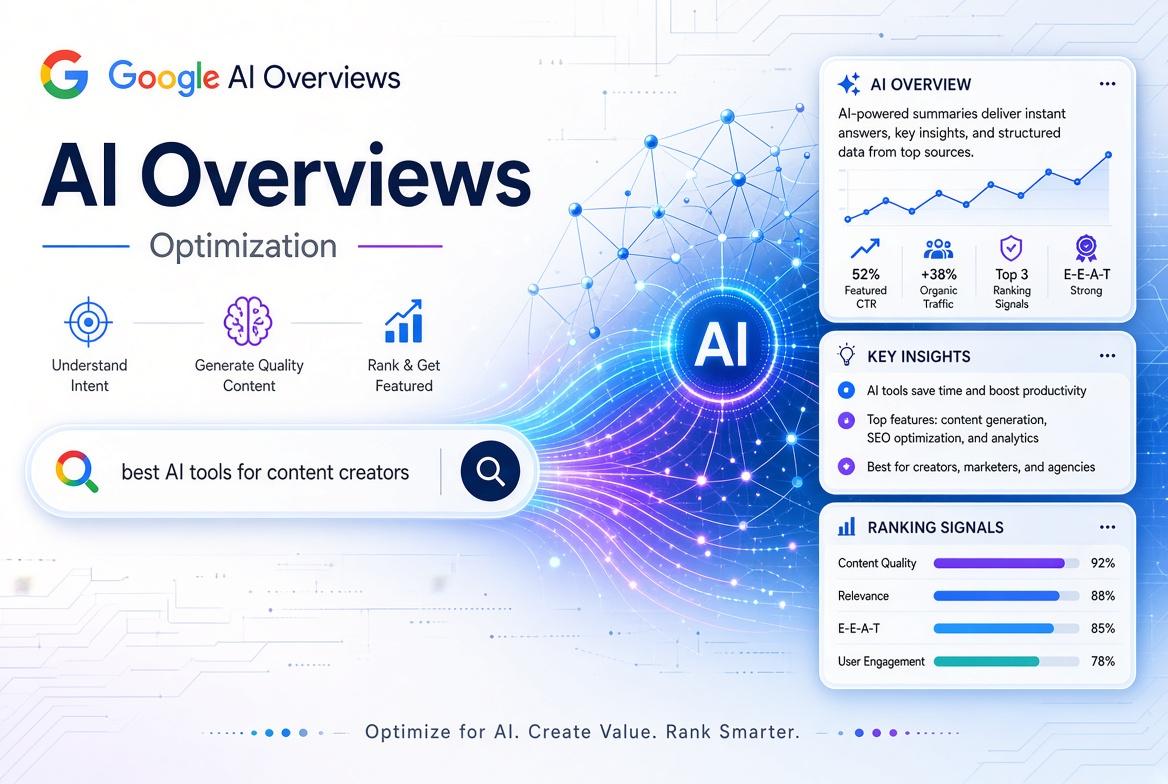
Search engine optimization is no longer evaluated only through traditional rankings and organic traffic. As Google introduces AI-generated summaries into search results, businesses also want to understand whether their websites are being cited, whether their brands are gaining visibility, and whether those appearances contribute to meaningful business outcomes.
However, measuring Google AI Overviews performance requires a more careful approach than simply checking a search result once and reporting a citation.
AI Overviews can vary across queries and search contexts. A website may appear as a source for one question but not another, while changes in search presentation may affect clicks even when organic rankings remain relatively stable.
A reliable measurement strategy combines traditional SEO reporting, repeatable citation checks, website analytics, and conversion tracking.
AI search visibility can help businesses understand how their content is represented in Google's AI-generated responses.
Tracking performance can reveal which pages are being cited, which topics have visibility gaps, and where content improvements may be worthwhile.
It can also help explain changes in organic search performance.
For example, a page might maintain a similar traditional ranking while experiencing a different click-through rate because the search results page has changed. Conversely, a page could gain impressions without producing a proportional increase in visits.
Monitoring several indicators provides a more complete picture than relying on rankings alone.
Before measuring the results of an AI Overview optimization campaign, document the website's current performance.
Select a group of priority queries that reflect your business objectives. Include informational questions, comparison searches, service-related queries, and relevant branded searches where appropriate.
For each query, record:
The search phrase and search intent.
The target page on your website.
The current organic ranking, where observable.
Whether an AI Overview appears.
Which sources are cited, if any.
Relevant organic impressions and clicks.
Existing traffic and conversion performance.
Keep the observation date, location, language, and device context consistent where possible.
This baseline helps distinguish actual changes from differences caused by search conditions or measurement methods.
One of the most direct ways to evaluate AI Overview visibility is to observe whether your website is cited in the AI-generated response.
Create a list of priority queries and check them on a consistent schedule. Record the cited domains, the exact pages linked, and the type of information each source appears to support.
For example, a digital marketing business might monitor questions about AI Overview optimization, technical SEO, and content strategy.
A useful tracking record could include:
| Metric | What it tells you |
|---|---|
| Query coverage | How many target queries were checked |
| Overview presence | Whether an AI Overview appeared |
| Citation frequency | How often your domain was cited |
| Page-level citations | Which URLs were cited |
| Competitor citations | Which competing sources appeared |
| Observation date | When the result was checked |
Calculate citation frequency only using a clearly defined denominator. For instance, divide the number of observations where your domain was cited by the number of valid observations in which an AI Overview appeared.
This makes comparisons more meaningful.
Manual checks are useful for smaller projects. Larger campaigns may benefit from specialized monitoring tools, provided the tool's methodology and data limitations are understood.
Google Search Console remains a core resource for evaluating a website's performance in Google Search.
Its Performance report provides information such as clicks, impressions, click-through rate, and average position. These metrics can be filtered by query, page, country, device, and other available dimensions.
For an AI Overview optimization campaign, create a baseline for the pages and queries being targeted.
Then compare performance over suitable periods while considering seasonality, search demand, algorithm changes, and content updates.
Important considerations include:
Impressions: Are priority pages appearing in search results more often?
Clicks: Are users visiting the website after seeing its listings?
Click-through rate: Has the proportion of impressions that produce clicks changed?
Average position: Are traditional organic rankings improving, declining, or remaining stable?
Search Console does not provide a simple dedicated report that isolates all AI Overview exposure and traffic. Therefore, these metrics should be interpreted as broader Google Search performance indicators rather than direct proof of AI Overview success.
Google Analytics or another web analytics platform can help evaluate what happens after visitors arrive.
Look at the pages targeted by the campaign and monitor relevant engagement and conversion metrics.
Depending on the business, these may include:
Organic landing-page sessions.
Engaged sessions.
Contact form submissions.
Product enquiries.
Demo requests.
Purchases or other completed goals.
Where analytics data is available, review landing pages alongside acquisition channels and conversion events.
A rise in organic visibility is useful, but the commercial value depends on whether the website attracts relevant visitors and supports the actions that matter to the business.
Do not assume that every increase in organic traffic was caused by AI Overview citations. Use documented changes and appropriate comparison periods to assess possible relationships.
Being mentioned in an AI-generated answer is not necessarily the same as receiving a clickable citation.
A response may name a company without linking to its website. Alternatively, the website may be cited as a source without the brand being prominently discussed in the answer.
For this reason, measure these outcomes separately:
Brand mentions: Does the response identify your business, product, or organization?
Website citations: Does the response link to a page on your domain?
Citation relevance: Does the linked page genuinely support the associated claim?
Competitive visibility: Which other businesses or publishers appear for the same queries?
These distinctions help identify whether the priority is improving brand recognition, strengthening the relevance of existing pages, or developing better content for specific search questions.
Competitor analysis can help explain why another website is being cited for a query that matters to your business.
Review the actual pages that appear in AI Overviews and compare them with your own content.
Look for differences in:
Coverage of the specific question.
Accuracy and depth of explanations.
Original examples or research.
Source attribution and supporting evidence.
Author and organization information.
Page accessibility and technical quality.
Internal links to related resources.
For example, a competitor may have a dedicated guide answering one narrow question while your website covers the subject only briefly within a broader service page.
That finding could justify creating a more useful supporting article or improving the relevant section of the existing page.
The aim is not to imitate competing content word for word. It is to identify gaps and provide a more useful, trustworthy resource.
When an article is updated, record what changed and why.
Changes may include improving the introduction, adding original examples, clarifying technical explanations, correcting factual errors, improving internal links, or resolving indexing problems.
After publication, monitor the target queries and page metrics over a suitable period.
Where practical, compare the updated page with its previous performance and with similar pages that were not changed during the same period.
This is not a perfect experiment because search results can change for many reasons. Nevertheless, documenting the changes and reviewing several indicators is more informative than making repeated edits without tracking outcomes.
Avoid attributing every movement in citations or rankings to one specific content change unless the evidence supports that conclusion.
AI Overview visibility is an intermediate indicator. Business value is better assessed by examining whether the campaign contributes to relevant outcomes.
A simple ROI framework can be expressed as:
ROI = (Attributed financial benefit − campaign cost) ÷ campaign cost × 100%
For example, suppose a campaign costs $2,000 and produces an estimated $3,000 in additional gross profit that can reasonably be attributed to the campaign.
The estimated ROI would be:
($3,000 − $2,000) ÷ $2,000 × 100% = 50%
This is an illustrative calculation, not a guaranteed outcome.
In practice, attribution can be difficult. Some visitors may discover a business through an AI-generated response and return later through direct traffic, branded search, or another channel.
Use conversion tracking, CRM records, customer surveys where appropriate, and transparent attribution assumptions to estimate business impact.
Avoid counting every AI citation as a lead or treating all observed traffic changes as incremental revenue.
A useful dashboard should connect visibility indicators with the business outcomes that justify the campaign.
Consider including these sections:
Number of priority queries monitored.
Percentage of checked queries showing an AI Overview.
Citation frequency and cited URLs.
Brand mentions and relevant competitors.
Search impressions and clicks.
Average position for target pages.
Organic landing-page sessions.
Changes in the performance of priority queries.
Qualified enquiries.
Conversion rate.
Sales or pipeline value where measurable.
Campaign cost and estimated return.
Pages updated.
Technical issues resolved.
New supporting content published.
Experiments completed.
Next actions and responsible owners.
A monthly report should explain not only what changed but also what the team recommends doing next.
Several reporting practices can lead to inaccurate conclusions.
Relying on one screenshot: A single search observation cannot establish consistent visibility.
Ignoring query selection: Results from a small, unrepresentative group of queries may not reflect the website's broader performance.
Confusing rankings with citations: Traditional organic position and AI Overview source selection are related areas of visibility but are not interchangeable metrics.
Ignoring seasonality: Changes in search demand may affect impressions and clicks independently of optimization work.
Overstating attribution: A citation does not prove that a customer visited the website or completed a conversion because of that citation.
Focusing only on visibility: A campaign should also consider whether the website attracts the right audience and generates meaningful business results.
A clear methodology and consistent reporting periods help reduce these errors.
The appropriate frequency depends on the number of target queries, the importance of the topic, and the level of volatility observed.
For a small campaign, checking priority queries weekly or at another consistent interval may be sufficient. Larger programs may use automated monitoring alongside periodic manual verification.
Organic traffic and conversions can be reviewed monthly, while urgent technical issues should be investigated as soon as they are identified.
The important principle is consistency. Keep the query set, observation method, and reporting definitions stable enough to identify meaningful trends.
Measuring Google AI Overviews performance requires more than counting citations. Businesses need to understand which pages appear, how organic search performance changes, whether their brand is represented accurately, and whether those efforts contribute to qualified leads or revenue.
A structured measurement process helps teams prioritize improvements, evaluate results, and allocate SEO resources more effectively.
Explore InnoSoftWorks' Google AI Overviews optimization services to learn how AI search visibility can be incorporated into a broader SEO strategy.
Start with a defined set of priority queries, establish a baseline, track citations consistently, and connect visibility reporting to the business outcomes that matter most.