

Every time I talk to someone about spinal decompression in Oak Creek, I notice the same thing. They have already heard a story. A neighbor told them it is just a stretching table. A forum post said it is a miracle cure. A relative warned them it would pull their back out of place. By the time they sit down to learn about it properly, they are carrying a bag full of half-truths.
I get it. Back pain makes people search for answers fast, and the internet is full of strong opinions. But decisions about your spine deserve better than rumors. So in this post I want to take the ten myths I hear most often and set each one next to what is actually true, in plain language.
To keep things concrete, I will refer to how one local clinic, Evolved Chiropractic, describes its program. Its page on nonsurgical spinal decompression in Oak Creek, WI explains its session length, schedule, equipment and the conditions it works with, which makes it a useful real-world reference point for separating fact from fiction.
Let us clear the air.
Why Myths Spread So Easily With Back Pain
Before we get into the list, it helps to understand why back pain attracts so many myths in the first place.
First, it is incredibly common. The World Health Organization reports that low back pain affected 619 million people worldwide in 2020 and calls it the leading cause of disability on the planet. When a problem touches that many lives, everyone has a story, and stories spread faster than research.
Second, back pain is unpredictable. The World Health Organization's overview of low back pain explains that around 90% of cases are non-specific, meaning no single disease or structural cause can be identified. That uncertainty creates room for guesses, and guesses easily harden into "facts."
Third, people naturally credit whatever they tried last. If someone's pain eased after a treatment, they often assume the treatment did it, even if the pain might have improved anyway. That is human, but it means personal stories are not always reliable guides.
With that in mind, here are the myths.
Myth 1: "Spinal Decompression Is Just Old-Fashioned Traction"
What People Picture
When people hear the word decompression, many imagine weights hanging off the end of a hospital bed, or a simple machine that pulls the same amount the whole time.
What Is Actually True
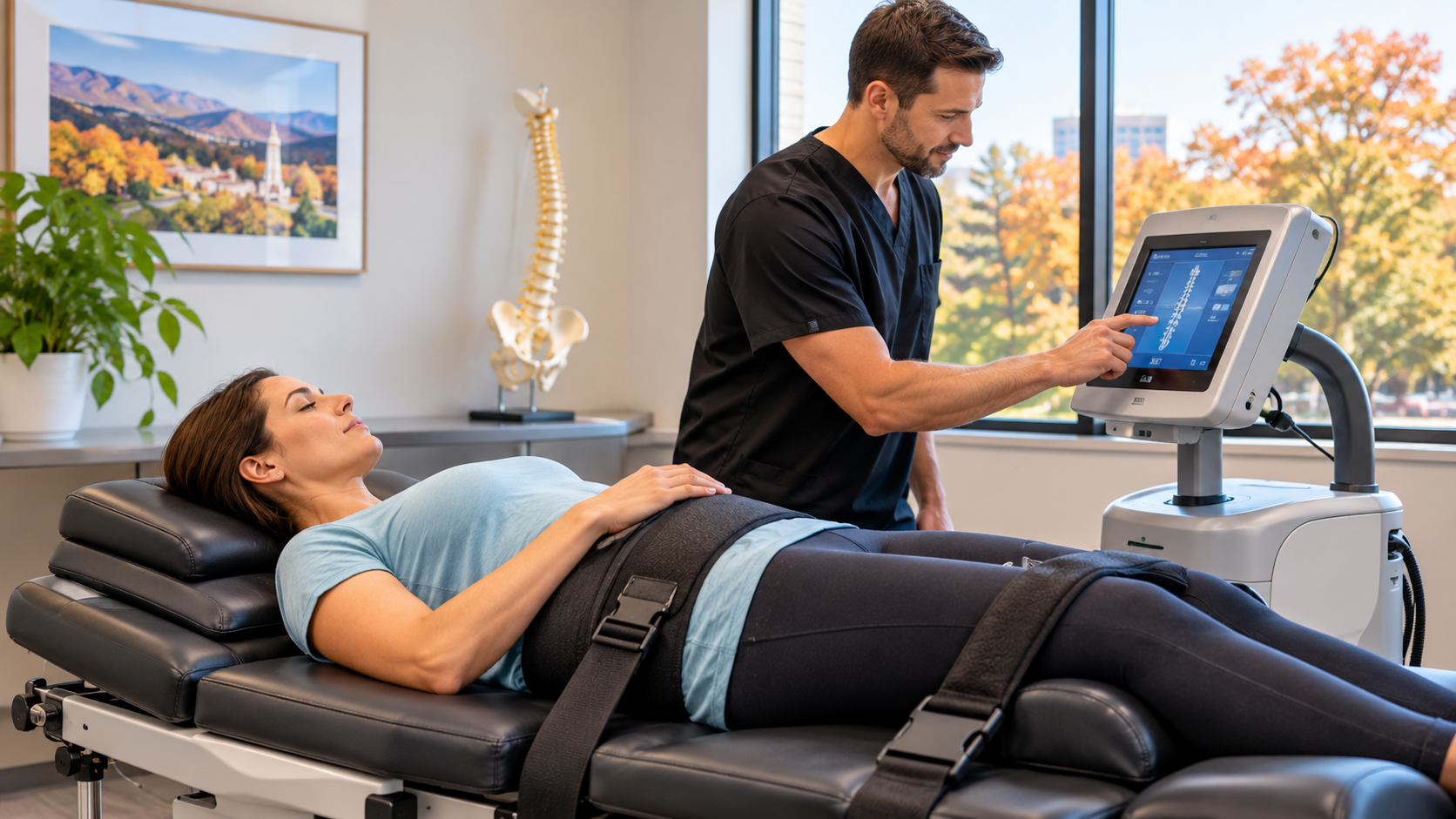
Modern nonsurgical spinal decompression shares a basic idea with traction: gently separating the vertebrae. But the way it is delivered is different. A computer-controlled table gradually increases the pulling force, holds it, and then eases off, in repeating cycles. Some tables can add slight side bending to target one side of the spine.
At the clinic I am referencing, the team uses a Chattanooga Triton m6 table with customizable protocols. The force is set based on the patient's age, body weight, general health, and the location and severity of the problem, which the clinic assesses with X-rays at the first chiropractic visit.
So while decompression and traction are related, calling decompression "just traction" ignores the customization, the cycling and the supervision that are central to how it is delivered.
Myth 2: "Decompression Hurts"
What People Fear
Being strapped into a harness and pulled sounds uncomfortable, so many people assume decompression must be painful.
What Is Actually True
For most people, it is not. The usual description is a gentle, steady stretch in the lower back. Many people find it relaxing, and some come close to dozing off during a session. Patients typically hold a safety switch that releases the tension immediately if anything feels wrong.
That said, it should never be sharply painful. If your pain spikes during a session, that is important information, and you should tell your provider right away so they can lower the force or change the angle. A good provider wants that feedback.
Myth 3: "One Session Will Fix My Back"
Where This Comes From
People sometimes hear stories of dramatic relief after a single visit and expect the same.
What Is Actually True
Spinal decompression in Oak Creek, as at most clinics, is delivered as a series of sessions, not a one-time fix. At Evolved Chiropractic, sessions last about 8 to 15 minutes and are usually scheduled 2 to 3 times per week. The clinic notes that many patients feel relief within the first few treatments, but feeling better early is different from finishing a plan.
The total number of visits depends on your condition, how long you have had it and how your body responds. A thorough provider will explain the expected plan up front and schedule progress checks so you know whether things are moving in the right direction.
Myth 4: "Decompression Works for Every Kind of Back Pain"
Why This Myth Is Tempting
When something helps one person, it is natural to assume it will help everyone.
What Is Actually True
Decompression is designed for problems that involve pressure: pressure inside a disc, pressure on a nerve root, or narrowing around the spaces where nerves exit the spine. That is why it is commonly used for conditions like:
- Herniated, protruding and extruded discs
- Sciatica
- Degenerative disc disease
- Spinal stenosis
- Facet arthrosis
- Grade 1 spondylolisthesis
Those are all on the list of conditions Evolved Chiropractic says its program can help with. But back pain can also come from sources that have nothing to do with disc pressure, such as hip joint problems, kidney issues, or muscle strains that are healing on their own. In those cases, decompression has less reason to help.
The honest truth is that the right diagnosis comes first. Decompression is a tool for specific problems, not a universal fix.
Myth 5: "If I Have a Herniated Disc on My MRI, Decompression Will Definitely Work"
Why People Believe It
If the MRI shows a disc problem and decompression targets discs, the logic seems airtight.
What Is Actually True
Imaging findings and pain do not always line up. Many people have disc bulges or herniations on an MRI without any symptoms at all, and some people with significant pain have relatively mild imaging. The real question is whether the disc on the scan is actually the source of your symptoms.
A good provider will compare your history, your exam findings and your imaging before deciding whether decompression makes sense. And even when it is a good fit, nobody should promise you a guaranteed result. Research on traction-based therapies for back pain is mixed, and outcomes vary from person to person.
Myth 6: "Decompression Is Dangerous"
Where the Fear Comes From
Pulling on the spine sounds risky, especially if you already have a damaged disc.
What Is Actually True
For properly screened patients, decompression is a gentle, non-invasive procedure with no incisions, no anesthesia and no recovery downtime. Most people return to normal activities right after a session.
The real safety issue is screening. Decompression is commonly avoided, or requires medical clearance, for people who:
- Are pregnant
- Have a recent spinal fracture
- Have spinal tumors or cancer affecting the spine
- Have a spinal infection
- Have severe osteoporosis
- Have fusion hardware, such as rods or screws, in the area being treated
- Have significant spinal instability
That is why a careful history and exam matter so much. Decompression is not risk-free for everyone, but it is low-risk for the right person.
A Note on Emergencies
Some symptoms are not a decompression question at all. If you have loss of bladder or bowel control, numbness in the groin or inner thighs, rapidly worsening leg weakness, or back pain with fever or a history of cancer, get emergency medical care right away.
Myth 7: "Decompression Means I Never Have to Exercise"
The Appeal
Lying on a table while a machine does the work sounds a lot easier than exercising.
What Is Actually True
Decompression is passive care. It may help calm symptoms, but strength, mobility and good movement habits are what help keep problems from coming back. That is why quality programs pair decompression with rehabilitation exercises and corrective care.
Evolved Chiropractic, for example, describes combining nonsurgical decompression with chiropractic adjustments, rehabilitation exercises and adjunctive therapies that support the ligaments, tendons and muscles around the spine. The clinic also recommends home exercise and periodic office visits to help maintain results and reduce the chance of recurrence.
Think of decompression as something that may open a window. Exercise is what you do with that window.
Myth 8: "Decompression and Chiropractic Adjustments Are the Same Thing"
Why People Mix Them Up
Both are offered by chiropractors, both are non-surgical, and both work on the spine.
What Is Actually True
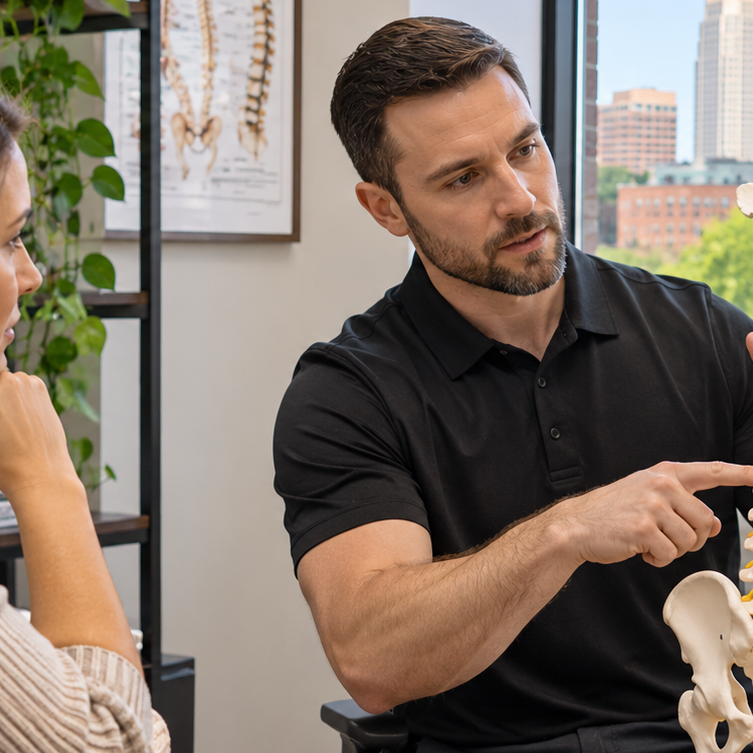
They are different tools for different parts of the problem. Decompression focuses on reducing pressure on discs and nerves through slow, cycled pulling. Adjustments focus on improving how the spinal joints move through controlled, hands-on force.
Many people need both. Stiff, restricted joints and an irritated disc often show up together. That is why a well-rounded plan for spinal decompression in Oak Creek frequently includes chiropractic care in Oak Creek, WI as a companion, so joint motion and disc pressure are both addressed.
Myth 9: "If I've Had Back Surgery, I Can't Try Decompression"
Where This Comes From
People assume any past surgery makes the spine too fragile for pulling forces.
What Is Actually True
It depends on the surgery. Some decompression programs specifically work with failed back surgery syndrome, which describes ongoing pain after spine surgery. Evolved Chiropractic lists it among the conditions it treats.
On the other hand, spinal fusion with rods or screws is commonly treated as a reason to avoid decompression at those levels. The answer is not a blanket yes or no. It is a careful review of your surgical history and imaging, ideally with records from your surgeon.
Myth 10: "Decompression Is Only for People Who Want to Avoid Surgery at All Costs"
The Assumption
Some people see decompression as a last-ditch effort for people who refuse surgery.
What Is Actually True
Most back pain care guidelines share a general principle: start with the least invasive reasonable option and escalate only when needed. That puts conservative care, including exercise, chiropractic care and decompression, ahead of injections and surgery for many people without emergency symptoms.
Seen that way, spinal decompression in Oak Creek is not a refusal of medical care. It is one reasonable step on a ladder of options. And a responsible provider will also tell you when decompression is not working and refer you for further evaluation, including surgical opinions when appropriate.
Bonus Myth: "Any Clinic's Decompression Is the Same"
I want to add one more, because it matters when you are choosing where to go.
Programs vary a lot. The table matters, but so do the exam, the customization of settings, the supporting care and the honesty of the provider. When you are comparing options for spinal decompression in Oak Creek, look for:
- A thorough history and physical exam before any treatment
- Imaging when it is needed, and a clear explanation of what it shows
- Settings tailored to your age, weight, health and condition
- A written or clearly explained plan with progress checkpoints
- Rehab exercises and home guidance, not just table time
- A willingness to refer you elsewhere if you are not improving
If a clinic skips the exam, promises guaranteed results, or pressures you into a large package before explaining anything, those are red flags.
How to Fact-Check What You Hear About Decompression
Here is a simple process I use whenever I hear a new claim about any back treatment:
- Ask what problem it is designed to solve. If a treatment claims to fix everything, be skeptical.
- Ask who it is not for. Any honest provider can answer this immediately.
- Look for sources. Health organizations like the WHO, MedlinePlus and NIH institutes publish plain-language information that is a good starting point.
- Separate stories from evidence. A friend's experience is real, but it is one data point.
- Watch for guarantees. Real healthcare rarely comes with promises.
That small habit will protect you from a lot of confusion, not only about decompression but about any treatment you consider.
Questions to Bring to Your Consultation
If you are curious about spinal decompression in Oak Creek after reading this, bring these questions to your first visit:
- What do you think is causing my pain, based on my exam?
- Why is decompression a good fit for my specific condition?
- Is there anything in my history that makes it unsafe for me?
- How will you choose and adjust my table settings?
- How many sessions should I expect, and when will we check progress?
- What exercises and habits will I need at home?
- What happens if I am not improving?
The way a provider answers these questions will tell you a lot about the quality of their care.
What a Real Decompression Session Looks Like, Step by Step
A lot of myths fade once people know exactly what happens in the room. Here is how a typical session unfolds at a well-run clinic.
- Check-in and quick update. Your provider asks how you have felt since the last visit, including any changes in leg symptoms, sleep or sitting tolerance.
- Getting positioned. You lie on a padded table, usually on your back. Harnesses go around your lower ribcage or upper torso and around your pelvis.
- Settings confirmed. The provider sets or adjusts the maximum force, hold and rest times, angle and session length based on your condition and progress.
- The cycles. The table slowly increases the pull, holds it, then eases off. This repeats for the length of the session, which at the clinic I referenced is about 8 to 15 minutes.
- Feedback. You tell the provider how it feels. The force or angle can be changed if anything is uncomfortable.
- Supporting care. Depending on your plan, the visit may include adjustments, rehab exercises or other therapies.
- Home instructions. You leave with guidance on exercises, activity and anything to avoid until the next visit.
Nothing about that process is dramatic or mysterious, which is exactly the point. Good decompression care is methodical.
What the Research Does and Does Not Tell Us
I want to be fair here, because myths come from both directions. Some people overstate the evidence for decompression, and others dismiss it entirely.
Here is a balanced way to think about it. Research on traction-style therapies for low back pain has produced mixed results, and studies vary a lot in the equipment, settings, conditions and patient groups they include. That makes broad conclusions difficult. At the same time, conservative, non-invasive care is widely recommended as a starting point for most back pain without emergency symptoms, and decompression is one of several conservative tools people explore.
What this means for you is practical. Do not choose spinal decompression in Oak Creek because someone promised you a guaranteed outcome, and do not dismiss it because someone told you it is fake. Choose it, or not, based on your diagnosis, a provider's honest assessment, and a trial period with clear checkpoints.
Who Tends to Be a Reasonable Fit
If you are trying to figure out whether decompression is even worth a consultation, here is a rough checklist. You may be a reasonable candidate to explore it if:
- Your pain is in the lower back, with or without leg symptoms
- Your provider or imaging points to a disc, stenosis or degenerative change as the likely source
- Your symptoms get worse with long sitting, bending or lifting
- You have tried basic home care without lasting relief
- You have no emergency symptoms
- You do not have conditions commonly screened out, such as pregnancy, recent fractures, severe osteoporosis, spinal tumors, infections or fusion hardware at the treatment area
That checklist is not a diagnosis. It is just a way to decide whether a professional evaluation makes sense.
Myth vs. Fact: A Quick Recap
If you skimmed to this point, here is the short version:
- Myth: It is just old traction. Fact: It uses computer-controlled, cycled force customized to you.
- Myth: It hurts. Fact: Most people feel a gentle stretch; sharp pain means the settings need adjusting.
- Myth: One session fixes it. Fact: It is delivered as a series, usually 2 to 3 sessions per week at the referenced clinic.
- Myth: It works for all back pain. Fact: It is designed for pressure-related spine problems.
- Myth: An MRI finding guarantees success. Fact: Imaging and pain do not always match.
- Myth: It is dangerous. Fact: It is low-risk for properly screened patients.
- Myth: No exercise needed. Fact: Active care is what helps results last.
- Myth: It is the same as an adjustment. Fact: They are different tools that often work well together.
- Myth: Past surgery rules it out. Fact: It depends on the type of surgery.
- Myth: It is only for surgery avoiders. Fact: It is one reasonable step on a ladder of conservative care.
A Final Word on Stories You Hear
Stories from friends and family are worth listening to, because they often reflect real experiences. Just remember that every spine, diagnosis and treatment plan is different. Use those stories as a starting point for questions, not as a prediction of what will happen to you.
My Honest Take
After spending a lot of time reading about and discussing this therapy, here is where I land. Decompression is neither a scam nor a miracle. It is a gentle, non-invasive option that makes the most sense for specific pressure-related spine problems, delivered by a provider who screens carefully, customizes the settings and pairs it with active care.
Most of the myths I hear come from one of two extremes: people who expect too much or people who expect the worst. The truth sits in the middle, and that middle is where good decisions get made.
Frequently Asked Questions
1. Is spinal decompression in Oak Creek the same as traction?
It is related but not the same. Both gently separate the vertebrae, but modern decompression uses a computer-controlled table that ramps force up and down in cycles, with settings customized to your condition and supervised by a provider.
2. Does decompression therapy hurt?
Most people feel a gentle, steady stretch and many find it relaxing. It should not be sharply painful. If your pain increases during a session, tell your provider right away so they can adjust the force or angle.
3. How many decompression sessions does it usually take?
It varies by condition and response. At the Oak Creek clinic referenced here, sessions last about 8 to 15 minutes and are usually scheduled 2 to 3 times per week, with progress reviewed along the way.
4. Can decompression help every type of back pain?
No. It is designed for pressure-related problems like disc herniations, sciatica, degenerative discs and stenosis. Pain from the hip, kidneys or a healing muscle strain is less likely to respond.
5. Is spinal decompression safe?
For properly screened patients it is gentle and non-invasive. People who are pregnant or have fractures, spinal tumors, infections, severe osteoporosis, fusion hardware or instability are commonly screened out or need medical clearance first.
6. Do I still need to exercise if I get decompression?
Yes. Decompression is passive care that may help calm symptoms. Rehab exercises and good daily habits build the strength and control that help keep pain from returning.
7. Is decompression the same as a chiropractic adjustment?
No. Decompression reduces pressure on discs and nerves through slow, cycled pulling. Adjustments improve joint motion through hands-on force. Many treatment plans use both.
8. Can I try decompression after back surgery?
Sometimes. Some programs work with failed back surgery syndrome, but fusion hardware at the treated level is commonly a reason to avoid it. Your provider should review your surgical records first.
9. Will an MRI tell me if decompression will work?
Not by itself. Imaging findings and pain do not always match. Your provider should combine your history, exam and imaging to decide whether decompression is a reasonable fit.
10. When should I skip decompression and go to the ER?
Get emergency care right away for loss of bladder or bowel control, numbness in the groin or inner thighs, rapidly worsening leg weakness, or back pain with fever or a history of cancer.
Final Thoughts
Myths survive because they are simple. The truth about spinal decompression in Oak Creek is a little more nuanced, but it is also more useful. It is not old-fashioned traction, it is not usually painful, it is not a one-visit fix, and it is not right for everyone. For the right person, with the right screening and the right supporting care, it is a reasonable conservative option worth a serious look.
So the next time someone tells you a decompression story, smile, listen, and then go get the facts from a provider who will examine you and explain your options honestly. Your back deserves decisions based on evidence, not rumors.