

Chiropractic Adjustment Techniques in Oak Creek: Diversified, Drop Table, Activator and NMFR Explained
When most people picture a chiropractic adjustment, they imagine one thing: someone lying on a table while the chiropractor gives a quick push and the spine makes a pop. That picture is not wrong, but it is incomplete. In my experience researching chiropractic adjustment techniques in Oak Creek and talking with people who have tried them, the biggest surprise for first-time patients is how many different ways an adjustment can actually be delivered.
Some techniques use hands-on manual adjustments. Some use a special table with sections that drop. Some use a small handheld instrument and no twisting at all. Others focus on the soft tissue around the joints instead of the joints themselves. Each one has a different feel, a different level of force and a different type of patient it tends to suit.
In this post I want to walk you through the four main approaches one local practice uses, explain each in plain language, and help you understand which might fit your body and comfort level. Evolved Chiropractic, led by Dr. Jon Mudlaff, D.C., describes these methods on its page about chiropractic adjustment techniques in Oak Creek, WI, and I will use that page as a reference point throughout.
Why Technique Matters at All
You might wonder why technique matters. Isn't an adjustment just an adjustment?
Not quite. Bodies are different. A college athlete with a stiff mid-back, a pregnant woman with pelvic discomfort, an older adult with sensitive joints and a toddler all need very different approaches. A technique that feels great for one person may feel too forceful, too uncomfortable or simply unnecessary for another.
That is why the clinic I am referencing describes its care as personalized, with adjustments tailored to each patient rather than one standard approach for everyone. The goal is the same across techniques, improving how joints move and supporting comfort and function, but the route to that goal changes depending on who is on the table.
A Quick Note on What an Adjustment Is
Before we compare techniques, it helps to know what an adjustment actually is.
The National Center for Complementary and Integrative Health (NCCIH), part of the U.S. National Institutes of Health, describes spinal manipulation as a technique where a practitioner uses their hands or a device to apply a controlled thrust to a joint of the spine. Most spinal manipulations are done by chiropractors.
The NCCIH's overview of spinal manipulation for low back pain notes that low back pain affects 8 out of 10 people at some point in their lives, and that spinal manipulation is one of several nondrug approaches that may be used to treat it. The same page says spinal manipulation may lead to small improvements in both pain and function, and that the American College of Physicians listed it in its 2017 guidelines as one of several options that may help people with acute or chronic low back pain.
I like that framing because it is honest. Adjustments are not magic, but they are a recognized, nondrug option that many people use as part of a broader plan.
Notice the phrase "hands or a device." That is exactly why there are several adjustment techniques. Some use hands. Some use instruments. Some use special tables. Let us look at each one.
Technique 1: The Diversified Technique
What It Is
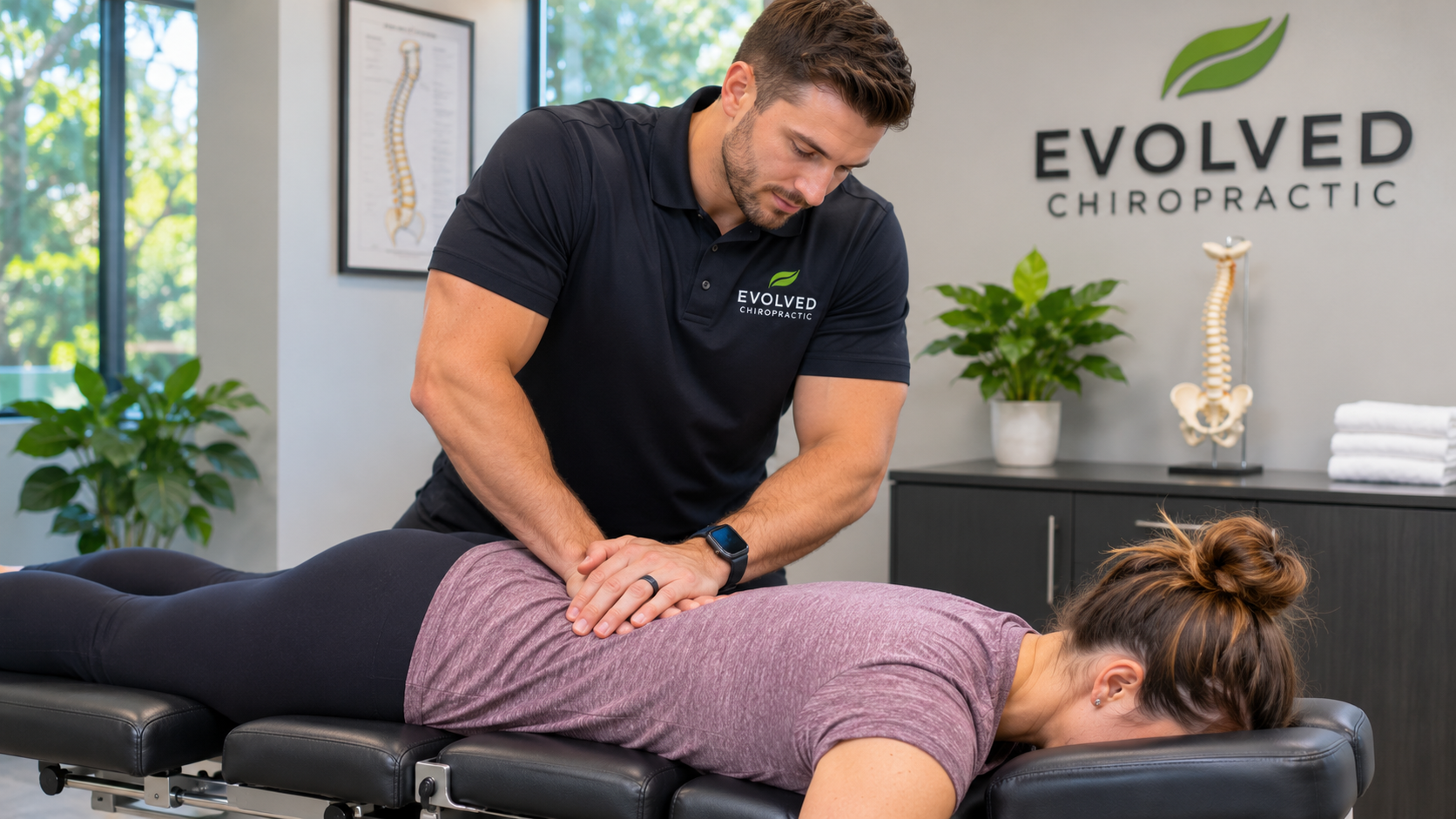
The Diversified Technique is the most widely used chiropractic method. It is what most people picture when they think of an adjustment: the chiropractor assesses how your joints are moving, then uses a precise, hands-on adjustment to restore motion in areas that are restricted.
According to the Evolved Chiropractic page, Dr. Jon pairs manual adjustments with motion assessment, and also uses the Motion Specific Technique within this category. The page says many patients find Motion Specific more comfortable.
What It Feels Like
You will usually be positioned on a table, lying on your back, side or stomach depending on the area being adjusted. The chiropractor places their hands on the target joint and applies a quick, controlled thrust. You may hear a pop or click. That sound is generally gas being released within the joint fluid, not bones cracking.
Many people describe a sense of release or looseness afterward. Some feel mild soreness for a short time, especially after their first few visits.
Who It Tends to Suit
- Adults with stiffness or restricted motion in the spine
- People dealing with posture-related tension from desk work or driving
- Athletes looking to keep their joints moving well
- Patients on corrective care plans aimed at posture and alignment
Benefits the Clinic Lists
The clinic's page names increased range of motion, reduced stiffness and pain, and better posture and performance as benefits of this approach.
Technique 2: The Drop Table Technique
What It Is
The Drop Table Technique uses a specially designed table with spring-loaded sections. The chiropractor sets a section of the table so it is slightly raised, then applies a quick, light thrust. As they do, that section drops a short distance. The drop helps deliver the adjustment with less force from the chiropractor's hands.
The Evolved Chiropractic page describes it as suited to patients who prefer less force or have joint sensitivity, and notes that it pairs well with spinal decompression for low back pain.
What It Feels Like
Most people describe it as a light tap followed by a soft thud as the table section drops. There is minimal twisting. You may hear the mechanical sound of the table more than any sound from your spine.
Who It Tends to Suit
- People who are nervous about traditional manual adjustments
- Patients with sensitive joints
- People with low back or pelvic discomfort
- Those who prefer minimal twisting or pressure
Benefits the Clinic Lists
The page highlights that it is gentle, uses minimal twisting or pressure, and is useful for pelvic and lumbar corrections.
Technique 3: The Activator Method
What It Is
The Activator Method uses a small, handheld, spring-loaded instrument. Instead of a manual thrust, the chiropractor places the tip of the instrument on a specific point of the spine or an extremity, like a wrist, ankle or shoulder, and delivers a quick, low-force impulse.
Evolved Chiropractic presents it as suitable for pediatric, prenatal and senior patients.
What It Feels Like
People often compare it to a firm, quick tap. There is no twisting, no rolling and no manual thrust. The impulse is very fast and localized. Many people who are anxious about adjustments find it far less intimidating.
Who It Tends to Suit
- Children
- Pregnant patients
- Older adults
- Anyone who wants a very specific, controlled adjustment without manual thrust
- People with joints in the arms or legs that need attention
Benefits the Clinic Lists
The page names suitability for all ages, high specificity and control, and the absence of manual thrust or twisting.
Technique 4: Neuro-Muscular Fascial Release (NMFR)
What It Is
Neuro-Muscular Fascial Release focuses less on the joint itself and more on the fascia, the connective tissue that surrounds muscles and nerves. When fascia becomes tight or restricted, it can limit movement and contribute to tension.
The Evolved Chiropractic page says NMFR is primarily used for pediatric patients, and describes it as releasing restricted fascia to support natural movement and neurological balance. The page presents it as a way to enhance traditional adjustments.
What It Feels Like
NMFR typically involves gentle, sustained contact and light pressure, rather than any quick thrust. For children, it can feel more like careful, gentle handling than a typical adjustment.
Who It Tends to Suit
- Pediatric patients, according to the clinic's description
- People who need soft-tissue work alongside adjustments
Benefits the Clinic Lists
The page names improved flexibility, reduced muscle tension and nerve irritation, and support for recovery and performance. Keep in mind that these are the clinic's own descriptions of its approach.
Comparing the Four Techniques Side by Side
Here is a quick comparison in plain language:
- Diversified (including Motion Specific): hands-on, quick thrust, most traditional, good for stiffness and posture-related tension.
- Drop Table: light thrust assisted by a dropping table section, minimal twisting, good for low back and pelvic issues and for people who prefer less force.
- Activator: handheld instrument, low-force impulse, no twisting, often used for children, pregnancy, seniors and extremities.
- NMFR: gentle soft-tissue release, no thrust, primarily used with pediatric patients at this clinic.
None of these is "better" across the board. The best one is the one that fits your body, your condition, your comfort level and your goals.
How a Chiropractor Chooses Your Technique
When you visit a practice that offers several chiropractic adjustment techniques in Oak Creek, the choice usually comes down to a few factors.
Your Age and Life Stage
A toddler, a pregnant woman and a 70-year-old are not going to receive the same adjustment. Lower-force options like the Activator and NMFR are often chosen for the youngest patients, while pregnancy and older age may call for gentler approaches as well.
Your Condition
Stiffness from desk work might respond well to Diversified adjustments. Low back pain that is part of a decompression plan might pair naturally with the Drop Table. Sensitive joints might call for the Activator.
Your Comfort Level
Some people love the feeling of a traditional manual adjustment. Others feel anxious just thinking about it. A good chiropractor listens and offers alternatives.
Your Health History
Conditions like osteoporosis, prior surgeries, certain neck problems and pregnancy can all influence which technique is safest. The NCCIH notes that risk may be higher for people with underlying health problems, and that patients should share their health conditions and medications with their practitioner.
How You Respond Over Time
Your technique is not locked in forever. Many people start with gentler methods and transition, or combine techniques, as their body responds.
What to Expect at Your First Visit
If you are new to chiropractic care, here is the general flow you can expect at most well-run practices:
- Health history. Your symptoms, how long you have had them, previous injuries, surgeries, medications and goals.
- Exam. Posture, range of motion, reflexes and specific movement or orthopedic tests.
- Imaging if needed. Some clinics use X-rays to better understand alignment and structural changes.
- Explanation. What the chiropractor thinks is going on and which technique they recommend, and why.
- First adjustment. Often gentler while your chiropractor learns how your body responds.
- Aftercare advice. Activity, posture and any home exercises.
The most important step is number 4. You should always understand why a specific technique is being recommended for you.
Possible Side Effects and Safety
Honest information about side effects is important. The NCCIH notes that mild-to-moderate temporary side effects of spinal manipulation can include increased pain or discomfort, stiffness or headache, and that most resolve within 24 hours. It also states that serious side effects are very rare.
That said, some situations call for extra caution or a different approach. Let your chiropractor know if you have:
- Osteoporosis or a history of fractures
- Any recent injury or surgery
- Numbness, tingling or weakness in your arms or legs
- A history of stroke or blood vessel problems
- Cancer, especially affecting the spine
- Pregnancy
This is one of the reasons multiple techniques exist. Lower-force options can sometimes be used when traditional manual adjustments are not the best fit.
If you ever experience sudden severe symptoms, such as weakness on one side of the body, trouble speaking, severe headache, loss of bladder or bowel control, or numbness in the groin, seek emergency medical care immediately.
How Adjustment Techniques Fit Into a Bigger Plan
Adjustments rarely work best on their own. At many practices, they are one part of a larger plan that may include:
- Corrective exercises and stretching
- Posture coaching for work and home
- Soft-tissue work
- Spinal decompression for certain disc-related problems
- Lifestyle guidance on sleep, activity and ergonomics
If your main concern is the spine itself, it is worth reading about how spinal adjustments for back and neck pain relief fit together with other parts of care, so you know what a complete plan might look like.
Questions to Ask About Adjustment Techniques
When you are comparing chiropractic adjustment techniques in Oak Creek, these questions help you understand your options:
- Which techniques do you use, and why are you recommending this one for me?
- Is there a gentler alternative if I am uncomfortable?
- How will you know if the technique is working?
- Will my technique change as I improve?
- What should I expect to feel after the adjustment?
- Are there any reasons a certain technique is not safe for me?
- What can I do at home to support my care?
A chiropractor who welcomes these questions is usually one who takes personalized care seriously.
Common Myths About Adjustment Techniques
A few misunderstandings come up again and again when people research chiropractic adjustment techniques in Oak Creek. Clearing them up makes the whole topic less intimidating.
"If It Doesn't Pop, It Didn't Work"
The pop is a side effect of how some manual adjustments move a joint, not the purpose of the adjustment. Instrument-based and table-assisted techniques often make no sound from the joint at all, and they are still designed to improve how that joint moves.
"Gentle Techniques Are Only for Kids"
Low-force methods like the Activator and Drop Table are often used with children, but plenty of adults choose them too, including people with sensitive joints, older adults, pregnant patients and anyone who simply prefers less force.
"Every Chiropractor Uses the Same Method"
Practices vary widely. Some focus on one technique, while others, like the clinic I have been referencing, use several so they can match the method to the person.
"Once You Start, You Can Never Switch"
Your technique can change. Many people start with a lower-force approach and later try other methods, or use different techniques for different areas of the body.
"More Force Means Better Results"
Force is not a measure of quality. The right amount of force is the amount that suits your body, your condition and your comfort level.
How Often Will You Need Adjustments?
This is one of the most common questions, and the honest answer is that it depends. The number and frequency of visits usually depend on:
- What you are being treated for and how long you have had it
- How your body responds to the first few visits
- Your goals, whether that is short-term relief or longer-term corrective care
- How well you keep up with home exercises and posture habits
A good chiropractor will explain a proposed schedule up front and tell you when progress will be reviewed. Be cautious of any plan that locks you into a large number of visits before you have even had a chance to see how your body responds.
What to Do After Your Adjustment
The hours after an adjustment are a good time to support your body. Here are a few simple habits many chiropractors recommend:
- Move gently. A short walk often feels better than sitting still for hours.
- Avoid heavy lifting right away. Give your body time to settle.
- Stay hydrated. It supports general recovery.
- Notice how you feel. Track any soreness, stiffness or improvement so you can report it at your next visit.
- Follow your home exercises. Stretches and strengthening work help maintain the benefits of your adjustment.
- Reach out with concerns. If soreness lasts longer than expected or something feels unusual, call your chiropractor.
For many people around Oak Creek, Franklin and South Milwaukee who sit at desks or drive long distances, adding regular movement breaks to the workday is one of the most helpful habits of all.
Choosing a Chiropractor Who Offers Several Techniques
If you are comparing practices, look for one that can explain its chiropractic adjustment techniques in Oak Creek clearly and offers more than one approach. A practice with several options can adapt as your needs change, whether that means switching to a gentler technique during a flare-up, using a drop table alongside decompression, or caring for different members of your family in different ways.
When to See a Medical Doctor Instead
Chiropractic care is not the right first step for every symptom. See a medical doctor or seek emergency care promptly if you have:
- Back pain after a serious fall, car accident or other significant trauma
- Pain along with fever, chills or unexplained weight loss
- A history of cancer and new back pain
- Numbness in the groin or inner thighs, or loss of bladder or bowel control
- Sudden, severe headache, dizziness, vision changes or trouble speaking
- Progressive weakness in an arm or leg
A responsible chiropractor will screen for these warning signs and refer you to a physician when needed. If you notice them before your visit, do not wait for your appointment.
My Honest Take
After looking closely at how practices describe their techniques, the main thing I want people to know is this: you have options. If the idea of a traditional "crack" makes you nervous, there are lower-force methods. If you have sensitive joints, there are gentler tables and instruments. If you are bringing in a child, there are techniques designed with small bodies in mind.
The best chiropractic care is not about one technique. It is about choosing the right tool for the right person, explaining it clearly, and adjusting the plan as the person responds. When you find a chiropractor who does that, the technique itself becomes less intimidating and much more about what helps you feel and move better.
One last practical point: write down how you feel before and after your first few visits. Simple notes on stiffness, comfort and movement make it much easier to judge whether a technique is the right fit for you.
Frequently Asked Questions
1. What are the main chiropractic adjustment techniques in Oak Creek?
At the Oak Creek practice referenced here, the main techniques are the Diversified Technique (including Motion Specific), the Drop Table Technique, the Activator Method and Neuro-Muscular Fascial Release. Each uses a different level of force and approach.
2. Which adjustment technique is the gentlest?
The Activator Method, the Drop Table Technique and Neuro-Muscular Fascial Release are generally considered lower-force options compared with traditional manual adjustments. Your chiropractor can help you choose based on your comfort and condition.
3. Does every adjustment make a popping sound?
No. Manual techniques like Diversified often produce a pop from gas releasing in the joint fluid. Instrument-based and soft-tissue techniques usually do not produce that sound.
4. What is the Diversified Technique?
It is the most widely used chiropractic method. The chiropractor assesses joint motion, then uses a precise hands-on adjustment to restore movement in restricted areas.
5. How does the Drop Table Technique work?
The table has spring-loaded sections that drop slightly as the chiropractor applies a light thrust. This helps deliver the adjustment with less force and minimal twisting.
6. Is the Activator Method safe for children and seniors?
The Oak Creek practice referenced here presents the Activator as suitable for pediatric, prenatal and senior patients because it uses a low-force, controlled impulse without twisting. Your chiropractor should still review your full health history first.
7. What is Neuro-Muscular Fascial Release?
NMFR is a gentle technique that focuses on releasing restricted fascia, the connective tissue around muscles and nerves. At the referenced practice, it is primarily used with pediatric patients.
8. Are there side effects from chiropractic adjustments?
Some people have temporary soreness, stiffness or headache, which usually resolves within about a day. Serious side effects are very rare. Share your health conditions and medications with your chiropractor before care begins.
9. Can I ask for a different technique?
Yes. A good chiropractor will explain your options and offer alternatives if a particular technique makes you uncomfortable, as long as the alternative is appropriate for your condition.
10. How do I know which technique is right for me?
Your chiropractor will consider your age, condition, health history, comfort level and goals. Ask why a specific technique is recommended and how progress will be measured.
Final Thoughts
Chiropractic adjustment techniques in Oak Creek are more varied than most people expect. From hands-on Diversified adjustments to the gentle Drop Table, the low-force Activator and soft-tissue NMFR, each approach exists because people are different.
If you have been hesitant to try chiropractic care because of what you imagined an adjustment would feel like, I hope this breakdown helps. Ask questions, share your comfort level, and look for a chiropractor who explains why a technique fits you. The right adjustment is the one that is chosen for your body, not just the one that is most common. Take your time, stay curious, and choose care that feels right to you.