

Fire Risk Assessment: What It Is, Who Needs One, and How to Do One in 5 Steps

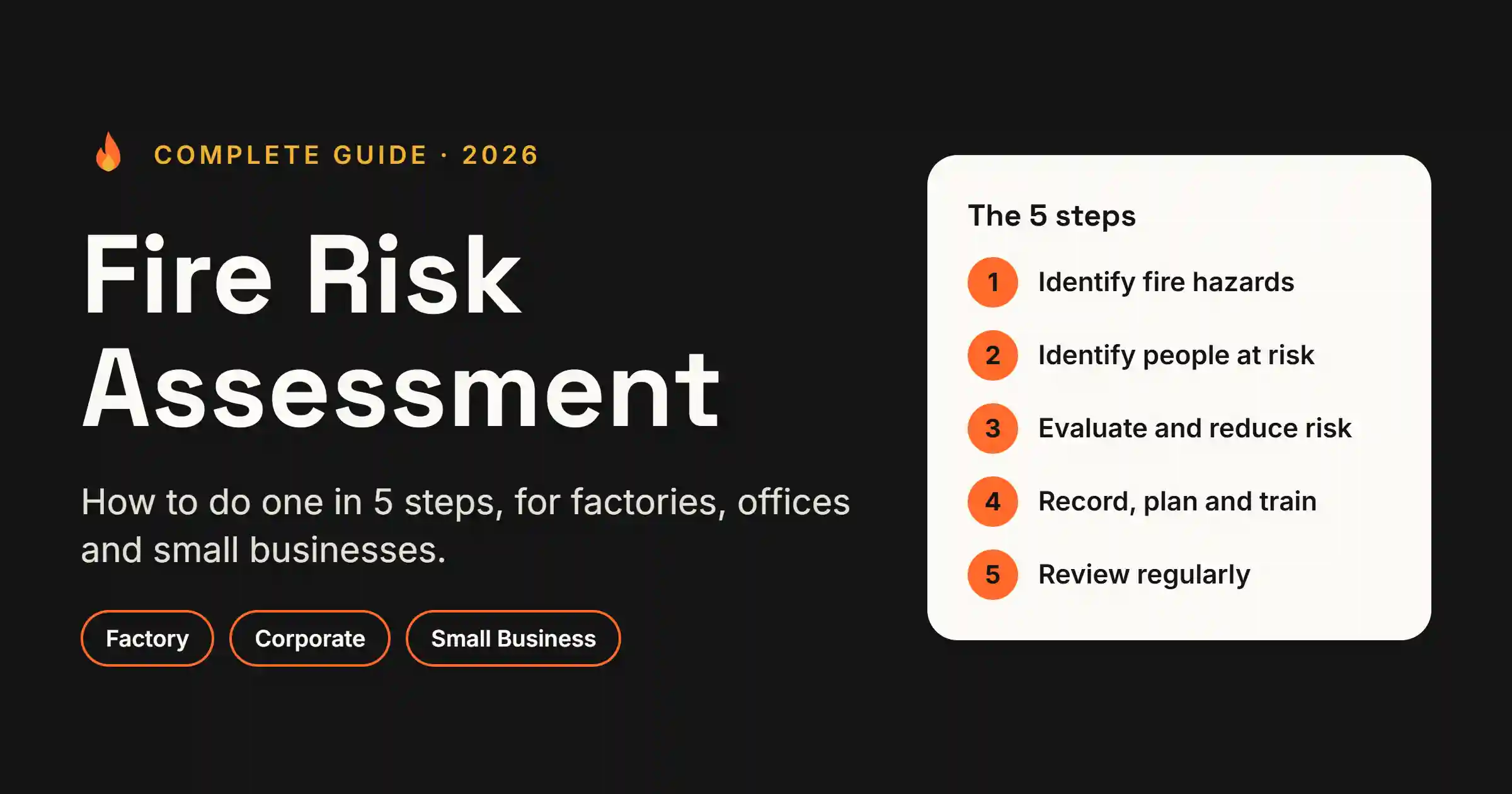
A fire risk assessment is a structured review of your premises that finds what could start a fire, who could be hurt, and what you must do to prevent it and get everyone out safely. You do it in five steps: identify fire hazards, identify people at risk, evaluate and reduce the risk, record and train, then review regularly. In most countries the employer or building controller is legally responsible for it, and even where it is not strictly mandated, insurers and fire authorities expect to see one. Write it down, act on the findings, and review it at least once a year or after any major change.
What is a fire risk assessment?
A fire risk assessment (FRA) is a documented, workplace-specific evaluation of fire hazards, existing fire precautions and escape arrangements. It answers four questions:
- What can ignite, and what can burn?
- Who is in the building, and could they escape in time?
- Are the current precautions (detection, alarms, extinguishers, exits, training) good enough?
- What must be fixed, by whom, and by when?
It is not the same as a fire drill, an inspection of extinguishers or an insurance survey. Those are parts of the picture. The assessment is the document that ties everything together and drives the action list.
Quick definitions
- Fire hazard: anything that can start a fire or make it spread (a heat source, fuel, or oxygen supply).
- Fire risk: the likelihood a fire starts multiplied by how bad the harm would be.
- Responsible person / duty holder: the employer, owner or manager legally in control of the premises.
- Competent person: someone with the training, experience and knowledge to assess fire risk properly.
- Fire triangle: heat, fuel and oxygen. Remove one and the fire cannot start or continue.
Is a fire risk assessment legally required?
In most jurisdictions, yes, or the same duty exists under health and safety or building law. Always confirm with your local fire authority, civil defence or labour department. Three well-known frameworks show how it works:
- England and Wales: the Regulatory Reform (Fire Safety) Order 2005 requires the responsible person for virtually all non-domestic premises to carry out a suitable and sufficient fire risk assessment and keep it up to date. Since 1 October 2023, amendments linked to the Building Safety Act 2022 require the assessment and fire safety arrangements to be recorded in writing, and the assessor’s identity to be noted. The older “five or more employees” threshold for written records no longer applies.
- United States: OSHA’s emergency action plan rule (29 CFR 1910.38) and fire prevention plan rule (29 CFR 1910.39), plus portable extinguisher rules (29 CFR 1910.157), set workplace requirements. NFPA 101 (Life Safety Code) and local fire codes add detail. Many fire marshals and insurers expect a documented hazard review.
- International: ISO 45001 occupational health and safety systems expect hazard identification and risk control, which includes fire. Many national building and civil defence codes require fire safety plans for factories and commercial buildings.
If you use an outside specialist, you still carry the legal responsibility. Hiring an assessor does not transfer the duty.
Why does fire risk assessment matter for businesses?
Because industrial fires are frequent, costly and often preventable.
- NFPA research estimates that US fire departments responded to roughly 37,000 fires a year at industrial and manufacturing properties, with around 18 civilian deaths, 279 injuries and about $1 billion in direct property damage annually (figures from NFPA reporting for 2009–2013, as summarised by secondary sources).
- NFPA’s large-loss fire reporting has found manufacturing and industrial properties accounting for the largest share of big-loss fire damage in some years, for example about 30.5% in 2022. Check NFPA’s current report for the latest edition.
- Beyond direct damage, fires cause stopped production, lost customers, cancelled insurance cover and, in the worst cases, deaths and criminal liability.
History is blunt about what skipped precautions cost. The 1911 Triangle Shirtwaist Factory fire in New York killed 146 workers, many trapped behind locked exits. The 2012 Ali Enterprises factory fire in Karachi killed more than 250 people, with blocked and barred exits and no working alarm widely cited in investigations. Both are textbook cases of failures a proper fire risk assessment is designed to catch.
How do you carry out a fire risk assessment? (5 steps)
Step 1: How do you identify fire hazards?
Walk the whole site, including roofs, stores, plant rooms and yards, and list the three things that cause fires.
- Sources of ignition: electrical equipment and wiring, heaters, machinery friction, hot work (welding, cutting, grinding), cooking appliances, smoking areas, static, battery charging.
- Sources of fuel: paper, packaging, pallets, textiles, plastics, foam, flammable liquids and gases, combustible dust, waste, oily rags.
- Sources of oxygen: natural air, plus oxygen cylinders, oxidising chemicals and air handling that can feed a fire.
Example: a garment unit finds lint building up around dryers (fuel), overloaded extension boards (ignition) and finished stock stacked under a ceiling-mounted light fitting (fuel next to heat).
Step 2: Who is at risk?
List everyone who could be affected, not just permanent staff.
- Night-shift and lone workers
- Visitors, customers and contractors
- People with disabilities, hearing or sight loss, or limited mobility
- Pregnant workers and those who do not speak the local language
- People working near high-hazard areas such as paint booths or chemical stores
For anyone who could not leave unaided, plan a personal emergency evacuation plan (PEEP) and name who helps them.
Step 3: How do you evaluate the risk and reduce it?
For each hazard, rate likelihood and severity, then decide what to do. A simple 1–5 matrix works for most sites:
|
Score (likelihood × severity) |
Rating |
Action |
|---|---|---|
|
1–4 |
Low |
Keep existing controls, monitor |
|
5–12 |
Medium |
Improve controls within a set date |
|
15–25 |
High |
Act now, stop the activity if needed |
Then apply the hierarchy of control: remove the hazard, substitute a safer option, reduce exposure, protect with engineering controls, and only then rely on procedures.
Worked example: a small workshop stores 200 litres of solvent beside a welding bay. Likelihood 4, severity 5, score 20 (high). Fix: move solvents to a ventilated, fire-rated cabinet away from hot work, cap the stored quantity, introduce a hot-work permit, and place a suitable extinguisher at the bay.
Also check your fire protection measures:
- Automatic fire detection and alarm, tested weekly
- Emergency lighting and exit signs
- Fire doors and compartmentation kept shut and undamaged
- Portable extinguishers of the right type, inspected and serviced
- Sprinklers or other suppression where required
- Clear escape routes, unlocked exits and a safe assembly point
Step 4: What do you need to record, plan and train?
Write down the hazards found, people at risk, actions taken, the person who did the assessment and the date. Add:
- An emergency plan (alarm, evacuation, roll call, calling the fire service, shutting down processes)
- Named fire wardens and enough of them per shift and per floor
- Induction and refresher training for all staff, plus at least one evacuation drill a year (more often in high-hazard sites)
- A log book for alarm tests, extinguisher checks, emergency lighting tests and drills
Step 5: How often should you review it?
Review at least every 12 months, and sooner after any of these:
- A fire, near miss or false-alarm pattern
- Layout changes, new machinery or a new process
- A change in stored materials or stock volumes
- Changes in headcount, shift patterns or tenants
- Building works or a change of use
- New law, an insurer request or an audit finding
What are the most common fire hazards by workplace type?
|
Workplace |
Typical hazards |
Quick fixes |
|---|---|---|
|
Factory / warehouse |
Combustible dust, flammable liquids, hot work, forklift and lithium battery charging, overloaded electrics, packaging and pallet storage |
Housekeeping schedule, hot-work permits, dedicated charging bay, dust control, storage height limits |
|
Corporate office |
Overloaded sockets, server rooms, blocked corridors, kitchens, storage in stairwells, contractor works |
Electrical testing, no-storage rule on escape routes, server room suppression, contractor induction |
|
Small business / shop |
Cooking equipment, stock piled near heat, waste bins by walls, shared building exits, poor electrical upkeep |
Waste kept outside, stock clearance from lights and heaters, portable appliance checks, clear exit signage |
What should a fire risk assessment checklist include?
- Premises description, occupancy numbers and operating hours
- Hazard list with ignition, fuel and oxygen sources
- People at risk, including vulnerable groups
- Existing controls and their condition
- Risk rating and action plan with owner and deadline
- Escape routes, exits, signage and lighting findings
- Detection, alarm and suppression findings
- Extinguisher types, locations and service dates
- Emergency plan and warden list
- Training and drill records
- Assessor name, qualifications, date and next review date
Who can carry out a fire risk assessment: you or a professional?
Small, low-hazard premises can often be assessed in-house by a trained manager using official guidance. Choose a professional fire risk assessor when your site is large or complex, stores flammable or explosive materials, has multiple tenants, sleeps people, or when your insurer or regulator asks for it.
Check an assessor for:
- Relevant qualifications and recognised accreditation or registration in your country
- Experience with your type of premises (for example, factories versus offices)
- Professional indemnity insurance
- Knowledge of standards such as PAS 79 (UK), NFPA codes (US) or your national code
What mistakes make fire risk assessments fail?
- Treating it as paperwork. An unused file protects nobody.
- Copying a generic template without walking the site.
- No action owners or deadlines, so findings never get fixed.
- Locked, blocked or obstructed exits, especially at night.
- Ignoring contractors, visitors and shift workers.
- Skipping reviews after layout, stock or process changes.
- Testing alarms but never running a drill.
- Poor housekeeping: dust, rags, cardboard and waste are fuel.
What happens if you do not have a fire risk assessment?
Consequences vary by country, but commonly include enforcement or prohibition notices, fines, prosecution of managers or owners, suspension of operations, refused or voided insurance claims, and civil liability if people are hurt. In the worst cases, deaths can lead to criminal charges. Having a current, acted-upon assessment is also your strongest evidence of due diligence.
Frequently asked questions
What is a fire risk assessment in simple terms?
A documented check of your premises that identifies fire hazards, who is at risk, and what you need to do to prevent fires and keep people safe.
What are the 5 steps of a fire risk assessment?
Identify fire hazards, identify people at risk, evaluate and reduce the risk, record findings and train people, and review regularly.
Who is responsible for a fire risk assessment?
The employer, owner or person in control of the premises. In multi-tenant buildings, responsibility is often shared between the landlord (common areas) and each tenant (their own space). You can appoint a competent assessor, but the legal duty stays with you.
How often should a fire risk assessment be done?
Review it at least annually and whenever something significant changes, such as layout, processes, stored materials, occupancy or after a fire or near miss. High-hazard sites often review more frequently.
Do small businesses need a fire risk assessment?
Generally yes. Size changes the complexity, not the duty. In England and Wales the duty applies to virtually all non-domestic premises and, since October 2023, written records are required whatever the number of employees.
Can I do my own fire risk assessment?
Yes, if the premises are simple and you are competent, using official guidance and a structured template. Use a professional for complex, high-hazard, multi-occupancy or high-occupancy sites.
How long does a fire risk assessment take?
A small shop or office may take a couple of hours on site plus writing time. A factory or large campus can take several days. Time depends on size, complexity and how well your existing records are organised.
What is the difference between a fire risk assessment and a fire safety audit?
The assessment is the legal, hazard-based review that sets the action plan. An audit checks whether your systems and records match your policy and the assessment. They work best together.
What fire safety equipment is required in a factory?
That depends on hazards and local code, but typically detection and alarm, emergency lighting, signage, clear exits, suitable extinguishers, and for high-risk or large buildings, sprinklers or other suppression and special protection for dust or flammable liquids.
How much does a fire risk assessment cost?
Costs vary widely by country, site size and risk level. Get written quotes from at least three accredited assessors and compare scope, not just price.
Does a fire risk assessment cover combustible dust and lithium batteries?
It should. Combustible dust, flammable liquids and battery charging are common industrial ignition and explosion risks. Consider specialist standards such as NFPA 652 for dust hazards and manufacturer guidance for batteries.
What should I do first after finding high risks?
Make the area safe immediately (stop the process, remove the fuel or isolate the equipment if needed), assign an owner and deadline, and record the action. Then update the assessment.