

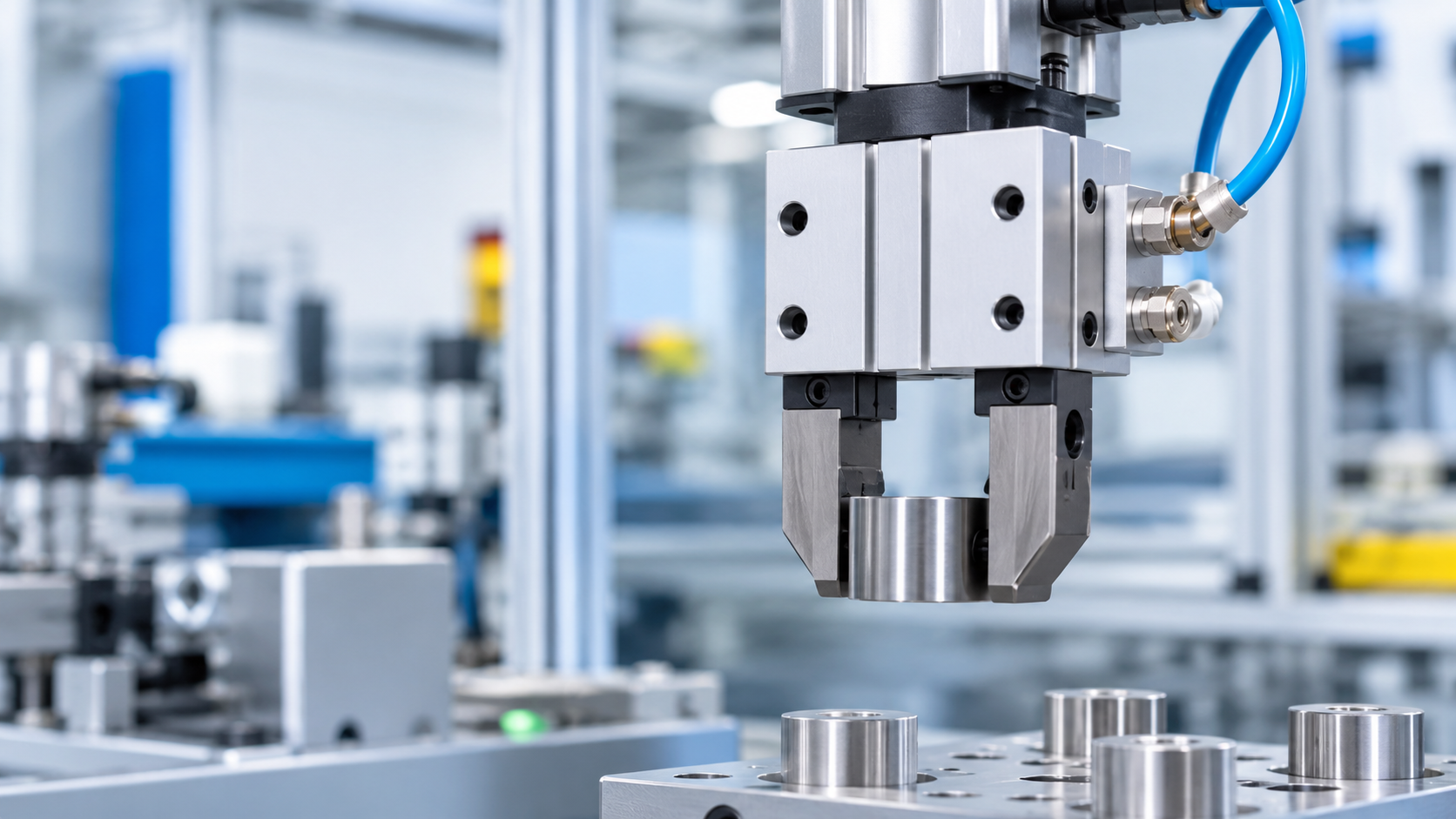

Automated production systems depend on accurate movement and secure component handling. Every part must move from one position to another without unnecessary delays or misalignment. Pneumatic gripping devices play an important role in making these operations consistent.
A Mercury Parallel Gripper is designed to hold and release components using two jaws that move in parallel. These devices are commonly considered for robotic handling, assembly lines, packaging machines, and other automated operations.
However, selecting a suitable gripper involves more than checking its size. Engineers must consider gripping force, jaw movement, workpiece dimensions, and operating conditions. This guide explains the important factors that industrial buyers should evaluate before selecting a gripper.
Understanding How a Pneumatic Parallel Gripper Works
A pneumatic parallel gripper uses compressed air to operate its gripping mechanism. Its two jaws move toward or away from each other while remaining parallel.
Custom gripping fingers can be attached to the jaws to suit different workpiece shapes. Their design determines how effectively the gripper contacts and holds the component.
Unlike angular grippers, which open and close through rotational movement, parallel grippers use straight-line jaw movement. This makes them suitable for many industrial handling operations where controlled contact and predictable positioning are required.
Businesses exploring Pneumatic Cylinders & Grippers should compare the available configurations according to their machine requirements.
Important Factors When Selecting a Mercury Parallel Gripper
1. Check the Weight and Dimensions of the Workpiece
The first step is understanding the component that needs to be handled.
A lightweight plastic component and a heavier metal part require different gripping arrangements. Engineers should record the component's weight, dimensions, material, and available gripping surfaces.
The gripper must provide sufficient holding force without damaging the component. Surface finish also matters because smooth or oily materials may require additional attention to finger design and friction.
Workpiece dimensions help determine the required jaw opening and the space available for gripping fingers.
2. Evaluate the Required Gripping Force
Gripping force is one of the most important selection parameters.
A gripper must hold the component securely during lifting, movement, and placement. The required force depends on workpiece weight, acceleration, friction, gripping orientation, and the application.
For example, a component being moved vertically may need additional protection against slipping compared with an application where the component is supported underneath.
The actual gripping force of a Mercury model depends on its specifications and operating pressure. Buyers should review manufacturer data rather than selecting a model using estimated force values.
3. Determine the Correct Jaw Stroke
Jaw stroke refers to the distance through which the gripping jaws travel during operation.
The selected stroke must provide enough clearance to approach, grip, and release the component.
A limited opening may prevent the gripper from handling larger parts. An unnecessarily large stroke can also complicate machine design or increase movement time.
Before purchasing an industrial pneumatic gripper, engineers should measure the required opening, component tolerances, and finger dimensions.
These details help identify a suitable model without adding unnecessary complexity to the automation system.
Consider the Mounting Arrangement and Available Space
Industrial machines often operate within limited installation areas. Therefore, mounting requirements should be evaluated during the selection process.
Check the gripper's body dimensions, mounting orientation, available clearance, and position relative to nearby machine components.
The gripping fingers must have enough room to open and close without interfering with surrounding equipment.
Some systems require an additional linear movement mechanism to position the gripper.
For such applications, a Mercury Twin Rod Cylinder may be considered because its guided structure helps restrict rotation during linear movement. However, load capacity, mounting compatibility, and operating conditions must be checked before combining the components.
Match the Gripper with the Pneumatic System
A parallel gripper works as part of a larger pneumatic arrangement.
The air supply, directional control valves, tubing, and operating pressure all influence its performance.
Engineers should verify that the available compressed-air pressure matches the selected gripper's approved operating range.
Suitable filtration and pressure regulation are also important because contaminated air and unstable pressure can affect pneumatic equipment.
The control valve must support the gripper's required actuation method and switching sequence.
Businesses can explore Solenoid Valves when planning pneumatic control systems for automated machines.
A properly coordinated arrangement helps maintain predictable gripping and releasing operations.
Industrial Applications of Mercury Parallel Grippers
Automotive Component Handling
Automotive production involves repeated handling of machined parts, small assemblies, and other components.
Parallel grippers can be integrated into automated loading, unloading, and transfer arrangements where their gripping capacity and finger design match the workpiece.
Packaging and Sorting Operations
Packaging machines require controlled movement of products between different stages.
A pneumatic parallel gripper can support picking, positioning, and transferring suitable products.
Electronics and Small Component Assembly
Some electronic assembly operations involve delicate or compact components.
A correctly selected gripper with suitable fingers and controlled force can help handle these parts while reducing the possibility of excessive contact pressure.
Robotic Pick-and-Place Systems
Robotic systems use gripping devices as end-of-arm tooling.
A parallel gripper for automation can support repeated pick-and-place operations when its weight, force, stroke, and mounting arrangement suit the robot and workpiece.
Common Mistakes to Avoid When Selecting a Gripper
Industrial buyers should avoid selecting pneumatic gripping equipment based only on its external dimensions or price.
Common selection mistakes include:
-
Ignoring the component's weight and centre of gravity.
-
Selecting insufficient gripping force.
-
Overlooking jaw stroke and finger dimensions.
-
Failing to check available operating pressure.
-
Ignoring acceleration and gripping orientation.
-
Not considering what happens during air supply failure.
These factors can affect handling reliability and machine integration.
A structured selection process helps buyers identify equipment that meets their operating requirements.
Choosing a Reliable Mercury Parallel Gripper Supplier
Industrial buyers often need technical assistance when selecting pneumatic components for new machines or replacement applications.
A reliable supplier should help customers identify suitable product configurations based on operating requirements rather than simply offering available stock.
V.S. Enterprises, based in Noida, supplies Mercury pneumatic products to industrial buyers, machine builders, and automation businesses.
Customers can explore the available Mercury Parallel Gripper range and share their workpiece details, operating requirements, and quantities to request assistance with model selection.
Providing complete application information helps the supplier confirm compatibility and relevant specifications before quotation.
Conclusion
Selecting the right parallel gripper requires careful consideration of the complete handling operation.
Workpiece weight, jaw stroke, gripping force, operating pressure, and mounting arrangements all influence the final decision.
A suitable gripping device should meet the mechanical and pneumatic requirements of the application while supporting reliable component handling.
Businesses exploring different Mercury Pneumatics products should review the manufacturer specifications and discuss their requirements with a knowledgeable supplier before making a purchase.
Frequently Asked Questions (FAQs)
1. What is a Mercury Parallel Gripper used for?
It is used for gripping and releasing components in automated systems, including assembly operations, robotic pick-and-place applications, and industrial material handling.
2. How do I select the correct gripping force?
Consider the workpiece weight, friction, movement direction, acceleration, and gripping arrangement. Use the manufacturer's technical data and an appropriate safety factor to confirm suitability.
3. Can a pneumatic parallel gripper handle different component sizes?
Yes, provided the selected model has sufficient jaw opening and compatible gripping fingers. The workpieces must also remain within the gripper's rated capabilities.
4. What information should I provide before ordering?
Share the workpiece weight, dimensions, required jaw stroke, gripping orientation, operating pressure, mounting requirements, and expected operating cycle.
5. Where can I buy Mercury Parallel Grippers in India?
V.S. Enterprises supplies Mercury pneumatic products from Noida to industrial buyers across India. Customers can contact the company to discuss model availability, specifications, and purchasing requirements.


