

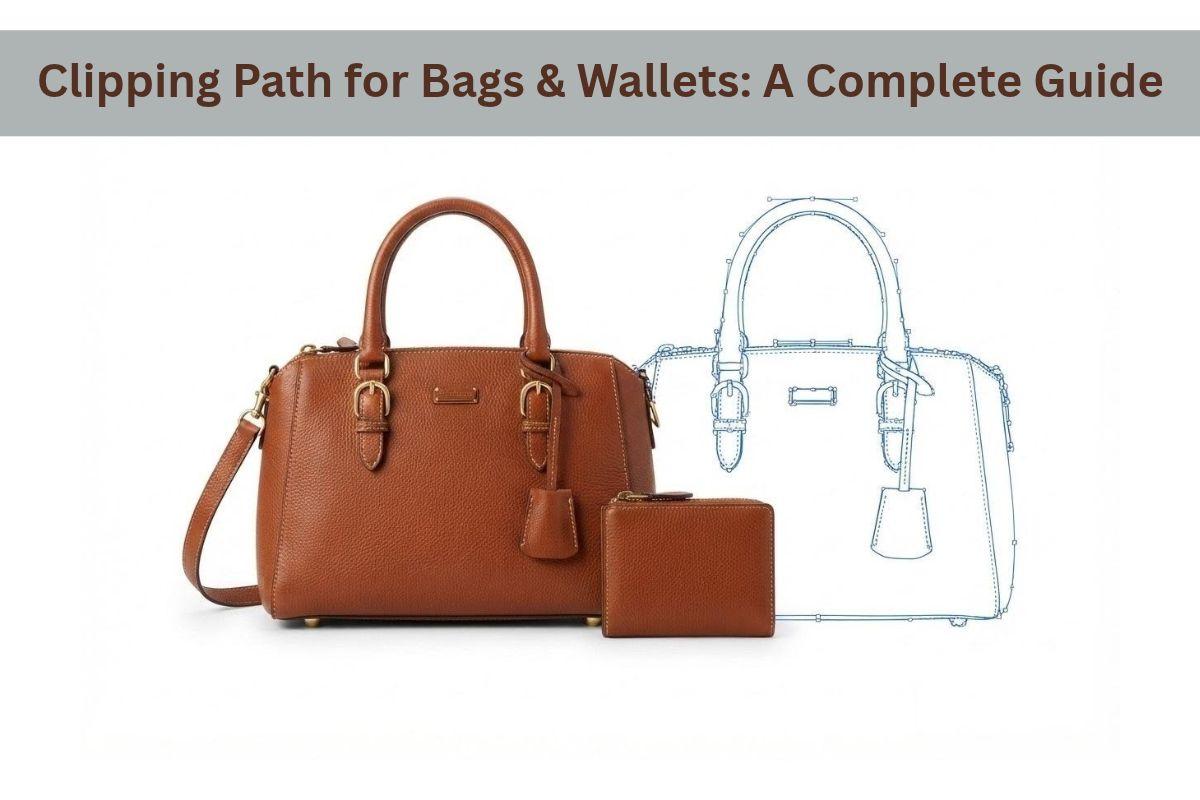
Clipping Path Service for Bags and Wallets: How to Handle Complex Edges and Details

For online fashion or accessory retailers, the end-user is totally dependent on the photos for craftsmanship, material, and durability. Buyers open the bag very carefully when it comes to buying a structured leather carryall, a minimal card holder or a vintage leather crossbody bag, zooming in on the grain of the leather and the neatness of the seams. To achieve this clarity of vision, there needs to be a special clipping path service that can isolate complex accessories without compromising on the very physical details of them. Bags and wallets are more complex than plain, rectangular products; they are shaped in odd ways, have reflective features, and include intricate threadwork that automated background removal tools often destroy.
Why Bags and Leather Accessories Need Manual Clipping Paths
Leather and luxury synthetic accessories are associated with natural attributes and are notoriously hard to edit. AI cutout tools are dependent on strong contrast between the object in the foreground and the background of the studio. Yet, where a tan leather wallet is against a warm-toned shadow, or a shiny patent handbag catches the light of the studio setting, automated algorithms can seamlessly blur the lines.
A manual image clipping path service overcomes these drawbacks by using hand-drawn vector paths using the Photoshop Pen Tool. Professional editors carefully trace the outline of a product, line by line, to make sure it has crisp edges that won't fall apart when zoomed in. This accuracy enables e-commerce brands to showcase their products on pure white backgrounds in their marketplaces and exciting lifestyle banners for their seasonal campaigns.
4 Key Challenges in Clipping Path Editing for Bags and Wallets
There are four different structural elements that are typical of bags and wallets, and retouchers need to skillfully maneuver themselves around these elements to create images that appear real, but not too manipulated to complete the catalog.
1. Fine Stitching and Thread Work
A quality leathercraft is typified by topstitching. The tightly closed ridges made by the saddle stitch or the simple, color-matched seams around the edge of a bi-fold wallet are examples of how threads can add tiny ridges to the edge of the product. If an editor makes the bumps appear flat and hard, the product fails to feel real. The subtle micro-undulations of the outer thread line are maintained during proper path creation, and this still preserves the handcrafted look that justifies premium price points.
2. Straps, Handles, and Negative Space
Handbags and backpacks are seldom of a single form. From the outside, the top handles, adjustable shoulder strap, D-ring loops and hanging leather tassels add pockets of negative interior space. Each space on the bag between a handle and the body must have its own closed vector path. These internal cut-outs are left exposed when not completed and cause an ugly frame of the original studio background right away when the image is set on a new background, making the viewer lose immersion.
3. Metallic Hardware and Reflections
Zippers, turn-lock clasps, chain straps and engraved buckles contribute to the harsh specular highlights and mirror-like reflections. The edges of the metal will blend in with the white sweep or grey walls of the photography studio, and polished brass, silver or gunmetal hardware tend to reflect the sweep or the walls. Experienced editors use geometric curves and sharp anchor points to draw out the precise perimeter of metallic pieces, and maintain the buckles' sharpness and metallic sheen.
4. Textured and Organic Surfaces
Leather surfaces aren't usually even, ranging from deeply pebbled full grain cowhide to exotic croc embossed finishes and brushed suede. In particular, suede and nubuck has microscopic fibers at the edges that can look "unnatural" if cut with a very sharp cut. The path feathering and the use of subtle edge refining in conjunction with the vector paths allows editors to get the smoothest and most realistic transitions between a textured hide and the underlying background, without the hide appearing flat or overly digital.
Maintaining Consistent Image Quality Across E-Commerce Catalogs
When a brand introduces a season's worth of clothing and there are hundreds of SKUs, it is vitally important to ensure that the edge quality is consistent on all angles — front, back, side profile and inside compartment — which builds brand confidence. If the photos of products seem to have perfect edges, and the product with the open zipper has rough edges, the consumer will notice they are not consistent.
By outsourcing the post-production to a dedicated clipping path service, all the products in a catalog are displayed in exactly the same manner. In addition to the simple background removal, multi-path enables the editor to select an area in a bag and isolate it separately, such as the leather body, the metal hardware and the inner lining. So it is easy to make adjustments to the metallic shine, correct leather colour variations, and even add realistic natural shadows to anchor the accessory to the page. Fashion companies and studio photographers rely on these complex and layered workflows, and companies such as Visuals Clipping specialize in providing them with professional imagery in a timely fashion.
Final Thoughts
High attention to detail in post-production will directly influence the buyer's confidence and conversion rate. With easy-to-see leather grain, a shiny clasp and accuracy of every stitch, there's no hesitation. Working with a dependable clipping path service can transform your studio images into intriguing visual possessions to help make your leather goods, pockets, and purses appear as elegant on-screen since they do in hand.
Also Read: Clipping Path with Shadow and Reflection: A guide


