Sulphonamides Market Advanced Pharmaceutical Solutions 2034
Other |
2026-09-21 16:12:49
 Russian
 English
 Romaian
 Portuguese (Brazil)
 Greek
Greek
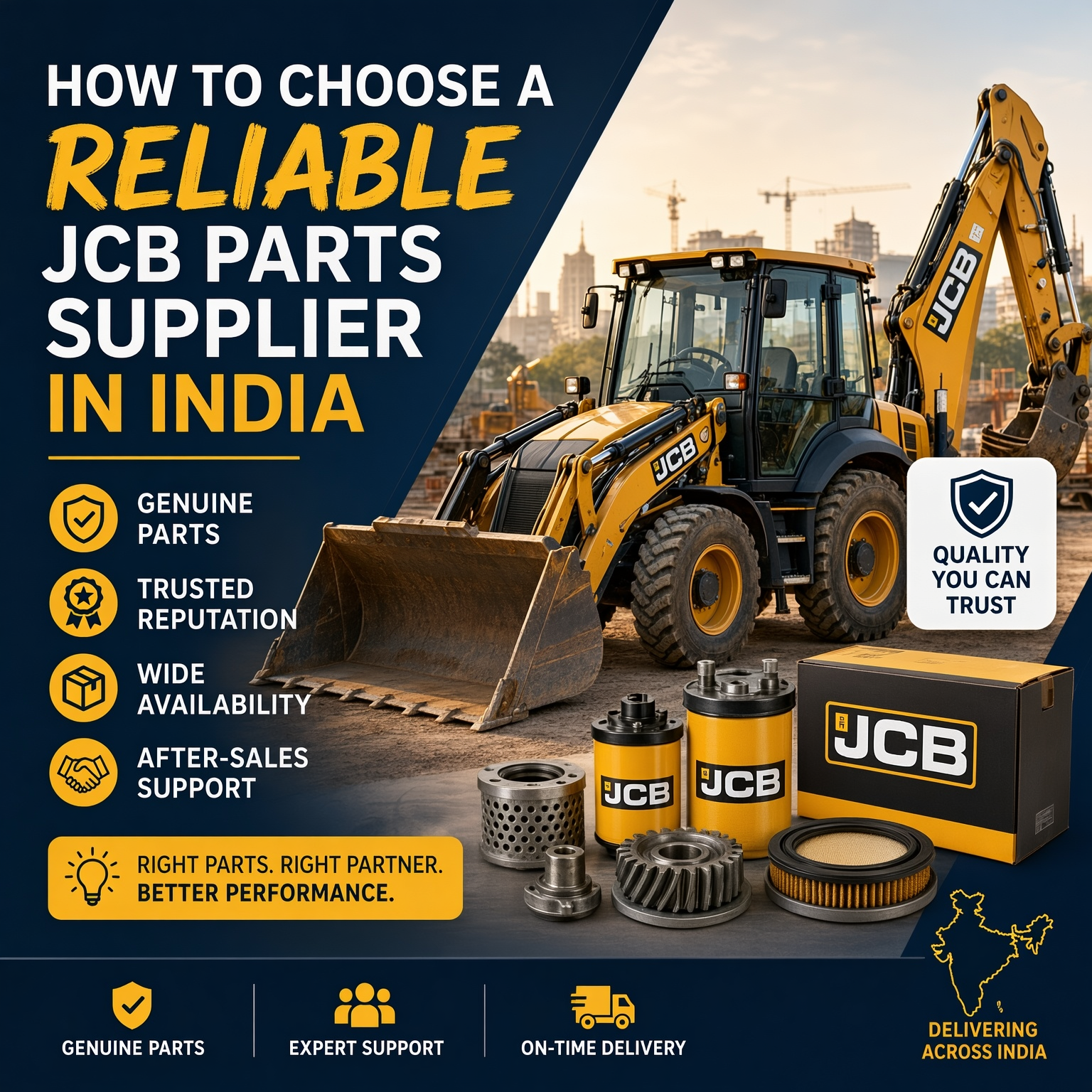
JCB machines operate in demanding environments, including construction sites, road projects, agricultural applications and other heavy-duty operations. Regular use can cause components to wear over time, and even a relatively small component failure can result in machine downtime.
Choosing the right JCB parts supplier is therefore an important part of equipment maintenance. Instead of selecting a supplier based only on price or convenience, buyers should verify compatibility, product information, supplier credentials and after-sales terms before placing an order.
This practical checklist explains what to check when comparing JCB parts suppliers in India.
JCB equipment regularly operates in dust, heat, mud and under heavy loads. Components such as filters, seals, pins, bushes, hoses and hydraulic parts may require periodic inspection and replacement.
Using a part that does not match the machine's specifications can result in poor fit, premature wear, reduced performance or additional maintenance requirements. The correct replacement part should be selected according to the machine model, serial number, application and relevant part number or technical specifications.
Buyers should also understand the type of part being offered. Depending on the requirement, suppliers may provide genuine/OEM parts or legitimate aftermarket replacement parts. These are different from counterfeit products that falsely claim to be genuine, as well as unverified parts whose quality or specifications cannot be confirmed.
Before ordering JCB spare parts, use the following checks to compare suppliers and reduce the risk of receiving an incorrect or unsuitable component:
Verify the supplier's company name, physical address, phone number, website and other relevant business details.
- Provide the exact JCB machine model and serial number, particularly when compatibility can vary between machine variants or production years.
- Confirm the required part number whenever possible. Check the old component, parts catalogue or machine documentation for reference.
- Share clear photographs of the existing component when the part number is unavailable or additional identification is required.
- Specify the quantity and application so the supplier understands exactly where and how the component will be used.
- Ask whether the product is genuine/OEM, aftermarket or another type of replacement part, and request relevant brand or manufacturer information.
- Confirm current stock status or expected dispatch time. Availability is particularly important when machine downtime needs to be minimized.
- Request a clear quotation that includes the product price, taxes, packaging, shipping charges and other applicable costs.
- Ask for a proper invoice containing the relevant product and transaction details.
- Review warranty, return and replacement terms before making payment, particularly for electrical, hydraulic or higher-value components.
- Check whether technical support is available to help identify the correct component or resolve compatibility questions.
- Confirm shipping and packaging arrangements, especially for fragile, electrical or precision components.
These checks provide more useful information than relying only on claims that a seller is "trusted" or "reliable."
Different JCB models can use different components, and parts may also vary according to serial number, configuration and application. A supplier should therefore request enough information to identify the correct replacement part rather than assuming that one component will fit every machine.
Before placing an order, provide the supplier with the machine model, serial number, required part number, quantity and application. Clear photographs of the old component and its labels or markings can also help with identification.
However, a photograph alone may not always be sufficient. Part numbers and machine details should be used whenever they are available.
Availability is an important consideration when a machine is out of service. Frequently replaced components may include oil, fuel and air filters, hydraulic seals, hoses, fittings, pins, bushes and other maintenance items.
However, no supplier should be expected to keep every JCB component in stock. Some specialized or model-specific parts may need to be sourced after an order is placed.
Ask whether the required item is currently available and confirm the expected dispatch and delivery dates before paying. This helps buyers plan maintenance and reduce unnecessary downtime.
Price is important, but the lowest quotation is not necessarily the best choice. Compare the product specification, brand, warranty, availability and supplier support alongside the price.
Buyers should also ask for the complete cost before ordering. This may include applicable taxes, packaging and freight charges. A written quotation can make it easier to compare offers from different JCB parts suppliers.
An unusually low price can be a reason to verify the product more carefully, but price alone does not prove whether a part is genuine, counterfeit or poor quality.
Depending on the machine model and its maintenance requirements, buyers may look for replacement components such as:
- Oil, fuel and air filters
- Hydraulic hoses and fittings
- Seal kits and O-rings
- Bucket teeth and side cutters
- Pins and bushes
- Brake and clutch components
- Radiator and cooling-system components
- Electrical switches, sensors and lights
The correct specification should always be confirmed for the particular machine rather than assuming that a commonly listed JCB spare part will be compatible.
Robot India supplies machinery spare parts and provides customers with a website and contact channels for product enquiries. Buyers looking for JCB parts can contact the company with their machine model, serial number, part number, quantity and application requirements.
As with any supplier, customers should confirm product specifications, availability, pricing, invoice details, warranty or return terms and shipping information before placing an order. This keeps the purchasing decision based on verifiable information rather than assumptions or unsupported recommendations.
Both local and online suppliers can be useful, depending on the part and the buyer's requirements.
A local supplier may allow buyers to inspect certain products in person, discuss requirements face to face and potentially arrange faster collection when stock is available. However, local availability may be limited for specialized or less commonly requested components.
Online JCB parts suppliers can provide access to suppliers outside the buyer's immediate area and make it easier to request quotations without travelling. The limitation is that buyers may not be able to inspect the component physically before shipment, making accurate part identification, supplier verification and clear return terms especially important.
Neither option is automatically better. The right choice depends on compatibility, availability, delivery time, total cost and after-sales support.
Counterfeit parts should not be confused with legitimate aftermarket components. A counterfeit product falsely represents itself as an original or branded product. A legitimate aftermarket part is manufactured as an alternative replacement and should be clearly identified as such.
There are also unverified parts where the manufacturer, specifications or quality cannot be adequately confirmed. Buyers should request clear product descriptions and avoid relying only on appearance or price.
Check the supplier's business details, request an invoice, confirm the manufacturer or brand where relevant and review warranty and return conditions. For components where quality or compatibility is difficult to establish, ask for supporting technical information before purchasing.
Choosing a reliable JCB parts supplier in India requires more than comparing prices. Accurate machine identification, correct part numbers, product specifications, availability, transparent pricing, invoices, warranty or return terms and technical support should all be considered.
Before contacting JCB parts suppliers, keep the machine model, serial number, required part number, photographs, quantity and application details ready. Whether purchasing from Robot India or another supplier, verifying these details before payment can reduce the risk of ordering an incorrect component and help keep maintenance and repairs on schedule.