Russian
 English
 Romaian
 Portuguese (Brazil)
 Greek
Greek

Heavy Duty Industrial Hose Assemblies Market Growth Drivers High Pressure Applications
Other |
2026-01-16 09:38:06
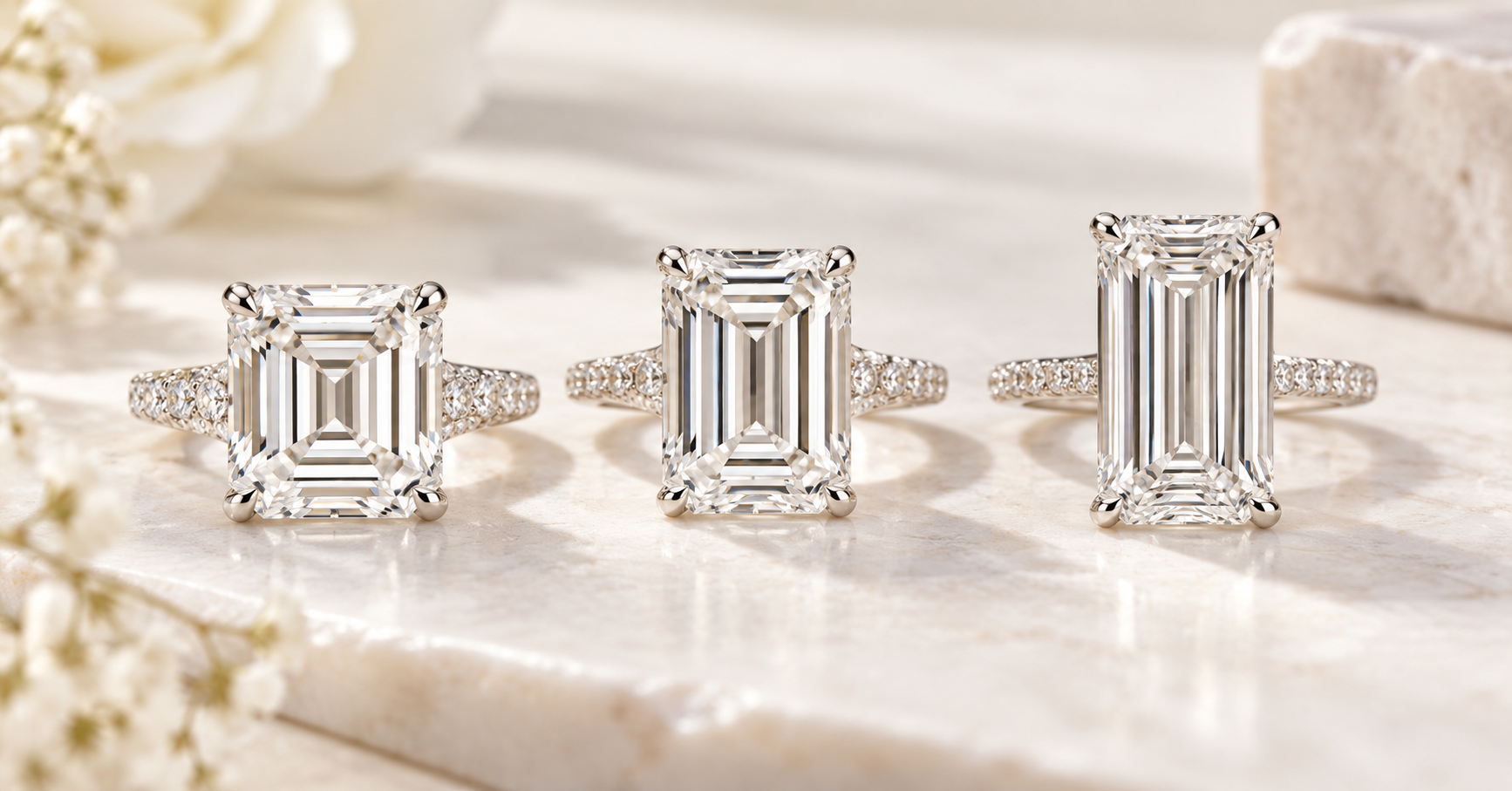
Choosing the right emerald cut diamond ratio can make a significant difference in how a diamond looks on an engagement ring. Unlike round diamonds, emerald cuts have a rectangular shape with step-cut facets that create an elegant, sophisticated appearance. When exploring different emerald cut engagement rings, understanding the diamond's length-to-width ratio can help you select a shape that matches your personal style.
Some emerald cut diamonds appear longer and slimmer, while others have a wider, more balanced appearance. Neither shape is necessarily better, but their proportions can influence how the diamond looks on your finger. This guide explains popular ratios, how to calculate them, and what to consider before purchasing.
The emerald cut diamond ratio refers to the relationship between a diamond's length and width. It determines whether the stone has a slightly square, balanced rectangular, or elongated appearance.
The ratio is calculated by dividing the diamond's length by its width.
Formula:
Length-to-Width Ratio = Diamond Length ÷ Diamond Width
For example, if an emerald cut diamond measures 8 mm in length and 5.5 mm in width:
8 ÷ 5.5 = 1.45
This means the diamond has a length-to-width ratio of approximately 1.45.
A lower ratio produces a wider appearance, while a higher ratio creates a more elongated diamond.
Understanding this measurement makes it easier to compare diamonds with similar carat weights but different shapes.
Many buyers prefer emerald cut diamonds with length-to-width ratios between 1.30 and 1.50. This range provides a traditional rectangular appearance while allowing flexibility in personal preference.
However, there is no universally perfect ratio. The most attractive shape depends on individual style, diamond proportions, and ring design.
Here is a comparison of common proportions:
|
Length-to-Width Ratio |
Diamond Appearance |
Best For |
|---|---|---|
|
1.00–1.15 |
Nearly square |
Buyers who prefer compact shapes |
|
1.16–1.29 |
Short rectangular |
Wider, less elongated styles |
|
1.30–1.39 |
Balanced rectangular |
Classic emerald cut appearance |
|
1.40–1.49 |
Elongated rectangular |
Elegant, traditional styles |
|
1.50–1.60 |
Long and slim |
Buyers who prefer an elongated shape |
|
Above 1.60 |
Very elongated |
Distinctive and dramatic designs |
These ranges are general style descriptions rather than official diamond grading standards.
Diamonds with ratios between 1.30 and 1.40 usually have a balanced rectangular shape.
They provide a traditional appearance without looking excessively long or wide.
This range works well with solitaire settings, three-stone rings, and vintage-inspired jewelry.
A ratio between 1.40 and 1.50 creates a longer rectangular appearance.
These diamonds are popular among buyers who prefer a slimmer shape that visually extends along the finger.
Elongated emerald cuts can look particularly attractive in simple settings that emphasize the center stone.
Emerald cut diamonds with ratios closer to 1.00 have a more square appearance.
They can offer a distinctive alternative to traditional rectangular emerald cuts.
However, buyers who specifically want a square step-cut diamond should also consider the Asscher cut, which has its own characteristic faceting and appearance.
The length-to-width ratio influences several visual characteristics of an emerald cut diamond.
The most noticeable difference is the diamond's outline.
A lower ratio creates a wider appearance, while a higher ratio makes the diamond look longer.
For example, a diamond with a 1.30 ratio may look noticeably different from one with a 1.50 ratio, even when both have the same carat weight.
Elongated diamonds can create the visual impression of longer fingers.
However, actual finger coverage depends on the stone's dimensions, not simply its ratio.
A longer diamond does not automatically have a larger visible surface area than a wider diamond of the same carat weight.
Symmetry is important in emerald cut diamonds because their parallel facets and straight edges make irregularities easier to notice.
A well-proportioned diamond should have an attractive outline, properly aligned corners, and visually balanced facets.
The length-to-width ratio alone cannot determine whether a diamond has excellent symmetry.
Different proportions may work better with certain engagement ring designs.
For example, elongated emerald cuts often complement solitaire settings, while shorter rectangular shapes can look attractive in three-stone arrangements.
The ideal choice depends on the complete ring design.
Carat weight and length-to-width ratio describe different characteristics.
Carat weight measures how much a diamond weighs, while the ratio describes its shape.
Two diamonds weighing one carat may have different dimensions and appearances.
A diamond with a higher ratio may appear longer, while another diamond with the same weight and a lower ratio may appear wider.
Depth also affects how large a diamond looks from above.
A deeper diamond may carry more of its weight below the visible surface, potentially making it appear smaller than a shallower diamond of the same carat weight.
When comparing diamonds, review actual millimeter measurements rather than relying only on carat weight.
Although the length-to-width ratio is important, other measurements also influence a diamond's beauty.
Depth percentage describes the diamond's total depth relative to its width.
An excessively deep diamond may appear smaller from above, while a very shallow diamond may have less desirable light performance.
There is no universally accepted ideal depth percentage for every emerald cut diamond.
Buyers should evaluate depth alongside overall appearance, measurements, and light performance.
The table is the large, flat facet on the top of a diamond.
Table percentage compares the width of this facet to the diamond's overall width.
Because emerald cuts have large open tables, the table size can influence their visual appearance.
Rather than selecting a diamond based on a single percentage, compare its overall proportions and appearance.
Emerald cut diamonds have cropped corners that distinguish them from ordinary rectangular shapes.
The size and consistency of these corners affect the stone's outline.
Well-balanced corners contribute to the diamond's overall symmetry and appearance.
Emerald cuts feature long, parallel step-cut facets.
Their arrangement creates the distinctive hall-of-mirrors effect associated with this diamond shape.
Even facet alignment helps produce an attractive pattern of light and dark reflections.
Emerald cut diamonds usually display inclusions more readily than brilliant-cut diamonds.
This happens because their large, open tables and broad step-cut facets provide fewer small reflections to disguise internal characteristics.
For this reason, clarity deserves careful attention when choosing an emerald cut.
Common clarity grades include:
FL (Flawless): No inclusions or blemishes visible under 10× magnification.
IF (Internally Flawless): No inclusions visible under 10× magnification, although surface blemishes may be present.
VVS1–VVS2: Very, very slightly included diamonds with extremely difficult-to-see inclusions under magnification.
VS1–VS2: Very slightly included diamonds with minor inclusions.
SI1–SI2: Slightly included diamonds with more noticeable inclusions under magnification.
Many buyers consider VS clarity grades when shopping for emerald cuts, but the right choice depends on the location and visibility of inclusions.
A lower-clarity diamond can sometimes appear eye-clean, while certain inclusions in a higher-clarity diamond may still deserve attention.
Always examine magnified photographs or videos and, when possible, inspect the diamond in person.
The engagement ring setting can influence how the diamond's proportions appear.
Solitaire settings feature a single center diamond.
They allow the emerald cut's shape and step-cut facets to remain the main focus.
Both balanced and elongated proportions can work beautifully in solitaire rings.
Three-stone settings feature a center diamond accompanied by two side stones.
Emerald cuts can be paired with tapered baguettes, trapezoids, or other complementary diamond shapes.
The size and shape of the side stones should balance the center diamond's proportions.
Halo settings surround the center diamond with smaller stones.
This design can increase the ring's overall visual presence and add sparkle around the emerald cut.
However, the additional stones may make the exact outline of the center diamond less noticeable.
Bezel settings surround the diamond's perimeter with a metal rim.
They offer a modern appearance and can help protect the diamond's edges and corners.
The bezel should be carefully designed to complement the stone's rectangular proportions.
Buying an emerald cut diamond requires more than selecting the desired carat weight.
Avoid these common mistakes.
A desirable ratio does not automatically mean the diamond has excellent light performance or symmetry.
Always review the diamond's complete characteristics.
Two diamonds with similar ratios can differ in physical size.
Compare their length, width, and depth measurements before purchasing.
A clarity grade provides useful information, but it does not fully describe how inclusions appear to the naked eye.
Examine the diamond's photographs or videos whenever possible.
Emerald cuts reflect light differently from brilliant-cut diamonds.
Look for balanced reflections, attractive contrast, and a pleasing hall-of-mirrors effect.
Avoid stones with persistent, distracting dark areas or excessive light leakage.
A diamond that looks attractive in a photograph may not match your preferred style when viewed in person.
Compare several shapes before making a final decision.
Finding the right emerald cut diamond becomes easier when you follow a practical selection process.
Step 1: Determine Your Preferred Shape
Decide whether you prefer a balanced rectangle, a slightly elongated shape, or a noticeably longer appearance.
Step 2: Compare Different Ratios
Start by comparing diamonds around 1.30, 1.40, and 1.50 to understand how the proportions affect appearance.
Step 3: Review Diamond Measurements
Check the diamond's length, width, and depth in millimeters.
This helps you understand its actual size rather than relying only on carat weight.
Step 4: Evaluate Clarity and Symmetry
Look for well-aligned facets, consistent corners, and inclusions that are not distracting during normal viewing.
Step 5: Examine Light Performance
Use clear photographs, high-quality videos, or an in-person viewing to evaluate the diamond's reflections.
Step 6: Choose a Suitable Ring Setting
Select a setting that complements the diamond's shape and provides appropriate protection.
Step 7: Review the Grading Report
Request an independent diamond grading report from a recognized gemological laboratory.
For GIA reports, remember that fancy-shaped diamonds such as emerald cuts do not receive an overall cut grade in the same way as standard round brilliant diamonds.
Yes. A ratio of 1.40 is a popular choice because it provides a balanced rectangular appearance with noticeable elongation. However, the diamond's overall proportions and visual quality are equally important.
Not necessarily. A 1.50 ratio creates an elongated appearance that many buyers find elegant. Whether it looks too long depends on personal preference and the ring setting.
The ratio itself does not determine diamond value. Price depends on several factors, including carat weight, color, clarity, cut quality, market demand, and whether the diamond is natural or laboratory-grown.
A 1.30 ratio produces a relatively wider rectangular appearance, while a 1.50 ratio creates a longer and slimmer shape.
No particular ratio guarantees the largest appearance. Face-up dimensions, depth, carat weight, and setting design all influence perceived size.
Choosing the ideal emerald cut diamond involves understanding how proportions affect shape, finger coverage, and overall appearance.
A length-to-width ratio between 1.30 and 1.50 is a useful starting point for buyers seeking a traditional rectangular diamond. However, personal preference matters more than following a single numerical standard.
Before purchasing, compare actual measurements, clarity, symmetry, light performance, and ring settings. Taking the time to evaluate these details will help you find an emerald cut diamond that matches your style, budget, and expectations.