Russian
 English
 Romaian
 Portuguese (Brazil)
 Greek
Greek

Solar Panel Operation and Maintenance Industry Analysis Key Drivers, Challenges & Opportunities
Other |
2026-06-08 09:41:23
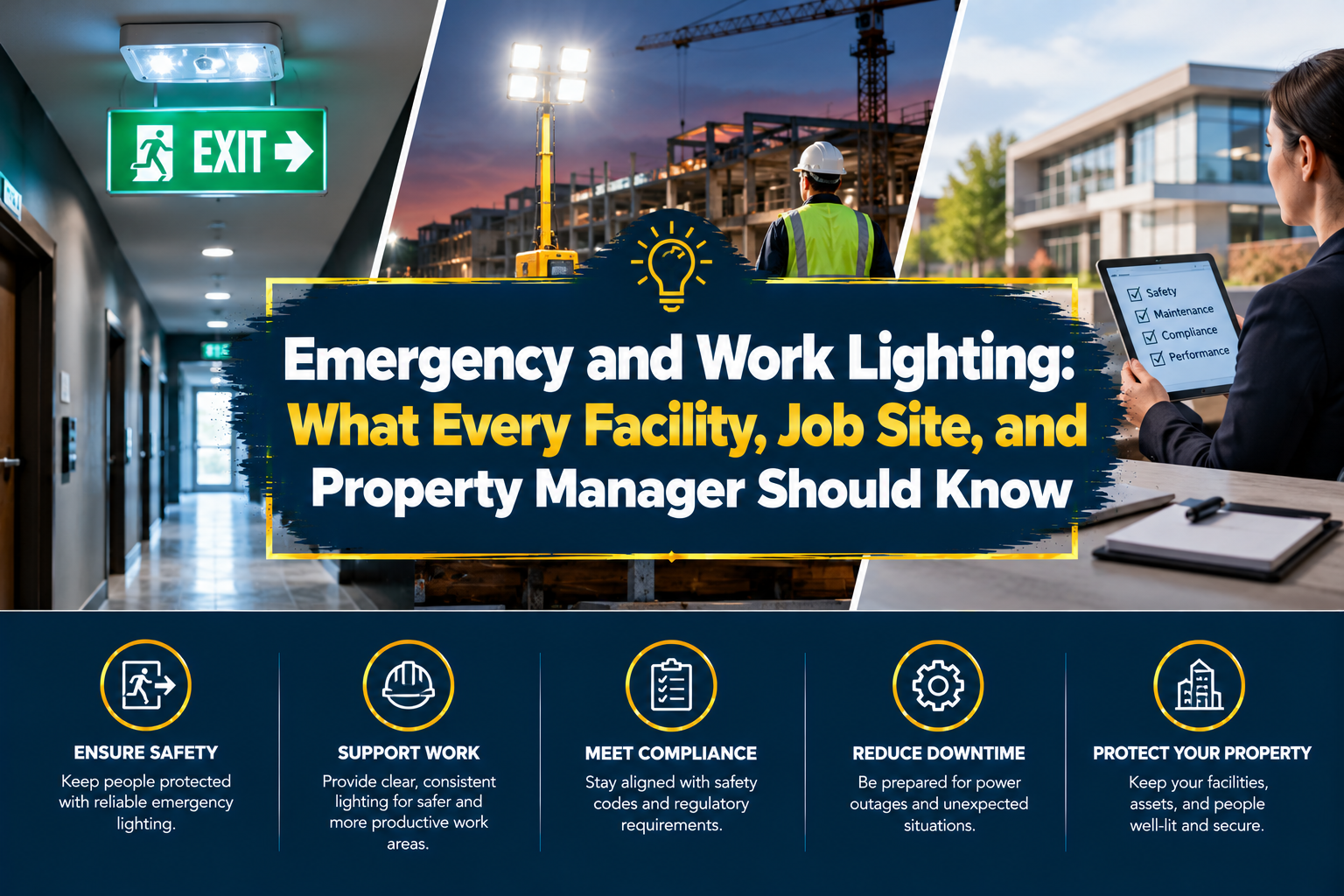
Most people only think about emergency lighting at the worst possible moment: the power drops, the room goes black, and suddenly everyone realizes how much they relied on a switch. By then it’s too late to plan. The best time to think about backup and safety lighting is when everything is working fine.
This guide covers where emergency and temporary lighting matters, what to look for when choosing it, and how to avoid the mistakes that leave people in the dark. If you’re comparing options as you read, you can browse this emergency lighting collection to see what kinds of fixtures are available for safety and job site use.
A power outage in a well-lit building is an inconvenience. A power outage in a dark stairwell, a crowded warehouse, or a busy construction zone is a hazard. Trips, collisions, and confusion all increase when visibility drops suddenly.
Building codes require certain safety lighting for good reason, but the real goal is simple: help people see where they’re going and keep working areas safe until normal power returns.
Construction sites change daily. Permanent lighting may not exist yet, or may be unreliable, so crews depend on portable, rugged lights to work safely at dawn, dusk, or in unfinished interiors.
Large, busy spaces with equipment, forklifts, and tall racking need strong, even light. When normal lighting fails, workers need enough illumination to stop machinery, move to safe areas, and exit calmly.
Offices, schools, retail stores, and hospitality venues all have stairwells, corridors, and exits where people could be caught in the dark. These areas typically need dependable backup lighting.
Even smaller spaces benefit from dependable portable lighting. A dark garage or an underlit workshop is a recipe for dropped tools and avoidable accidents.
Homeowners in storm-prone regions often keep backup lighting for outages. It doesn’t need to be elaborate, but it should be easy to find and ready to use.
Emergency lighting is designed to activate during a power failure and help people evacuate or stay safe. Exit signs and battery-backed fixtures are typical examples, and they’re usually governed by local building and fire codes.
Work lights are built to deliver bright, practical illumination for tasks: building, repairing, inspecting, or finishing. They’re often portable, rugged, and designed for rough conditions. In a pinch, they can also provide strong temporary light when other systems are down.
If your building needs code-required emergency lighting, a work light alone won’t satisfy that requirement. Always confirm what your local authority requires before deciding what to install. For job sites and temporary needs, though, durable work lights are often exactly the right tool.
Higher wattage generally means more light, but it also means more power draw and heat. Match the fixture to the space. A small repair bay doesn’t need the same output as an open warehouse floor.
Cooler white light, around 5000K, resembles daylight. It helps workers see detail, spot hazards, and stay alert. Warmer light feels softer but is less effective for demanding tasks.
Look for rugged housings that can handle drops, dust, and moisture. An IP rating tells you how well a fixture resists dust and water. Higher numbers mean stronger protection, which matters for outdoor or damp environments.
Many commercial fixtures accept a wide voltage range, which makes them easier to use across different sites. Confirm the plug and voltage match your setup before you buy.
Some fixtures can be daisy-chained, so one power source runs several lights. This saves outlets and extension cords and helps you light a long corridor or large area quickly.
Consider how you’ll use the light. Will it hang from a hook, sit on a stand, or mount to a fixed surface? Portable options are flexible, while fixed lights suit permanent setups.
Treating all safety lighting as interchangeable: code-required fixtures and portable work lights serve different purposes.
Under-lighting large areas: one bright light can’t replace proper coverage across a wide space.
Ignoring the environment: a fixture rated for dry indoor use won’t last on a rainy job site.
Forgetting maintenance: batteries age, lenses collect dust, and cords wear out. Inspect your lighting regularly.
Waiting until an outage: test your backup lighting before you need it.
Go through the area at night, with the lights off if it’s safe to do so. Where would people get confused or stuck? Those are your priority spots.
Check local codes if the space is commercial or public. For job sites, review your safety plan and any site-specific rules.
Pick brightness, durability, and mounting style to fit the actual conditions, not the ideal ones.
Create a schedule to check lights, batteries, cables, and mounts. A quick routine check is far cheaper than an accident.
Good safety lighting is easy to ignore until the moment it matters, and that’s exactly why it deserves planning. Think through where people work, move, and exit your space, then choose lighting that fits those needs and meets any code requirements. When you’re ready to compare fixtures, have a look at this range of LED linkable and work lights and match the wattage, durability, and format to your project.